
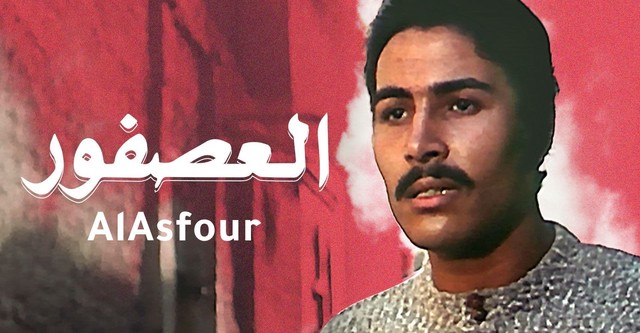
 The Sparrow (Youssef Chahine, 1972)
Amid his melodramas, autobiographical films, and allegorical-historical epics, Youssef Chahine’s The Sparrow stands out as a film trying something quite unique: to comment almost directly on very recent history. Made in 1972, it is a film looking back, and grappling with, the events around the Six Day War of 1967. This was a war in which the combined Arab forces of Egypt, Syria and Jordan slumped to a crushing military defeat to Israel in just six days. This cataclysmic humiliation was an era-defining moment. And yet, nobody in Egypt had seen it coming. Egyptians had taken it for granted that they would overpower Israel, small and surrounded. Five years on, they still could barely comprehend it. Five years is hardly enough to gauge the lasting legacy of this event’s reverberations, nor is it much of a vantage point to fully grasp the big picture of how and why it happened. Chahine was taking on a challenge that fiction cinema at that time had rarely attempted.
Films in the ‘present tense’
Even looking at 21st century cinematic attempts to dramatise big events in the process of being historicised, events still being digested by historians and commentators, what we find is a mixed bag. The Social Network (2010), David Fincher and Aaron Sorkin’s character study of Mark Zuckerberg and Facebook is one that has aged relatively well, just as its subject has grown in dominance and controversy (in some ways the film is prophetic about Big Data and its control over our lives). But you also have biopics of questionable necessity about Steve Jobs (two of them no less), the Wikileaks saga (Assange played by Benedict Cumberbatch), or the Brexit campaign (Dominic Cummings played by Benedict Cumberbatch). You have Oliver Stone’s cliché-ridden Snowden biopic (better to watch Laura Poitras’ Citizenfour with all the immediacy of history actually happening, exactly what fiction cinema’s past tense cannot offer!). These films do little to better understand the events they fictionalise. They mostly rely on audiences getting a kick out of seeing famous people and their lives re-enacted onscreen (see my article on the appeal of biopics), without distilling the context into a clearer picture. What good is the past if we are not learning lessons from it? Even Michael Winterbottom’s This England, a panoramic fly-on-the-wall re-living of the Covid lockdown and the British government’s handling of it, with its six-hour runtime, only seems to repeat what the UK lived through rather than crystallise some wider conclusions from the historical tea leaves.
An Egyptian panorama
Chahine is more ambitious than those examples, perhaps biting more than he can chew in just one feature film, but using his uncanny radar for capturing the zeitgeist in Egypt and drawing on the research and interviews he carried out around the country. He understood that a conventional narrative would not work for his ambitions here, and The Sparrow hence constitutes a major step in his artistic evolution. Crucially, Chahine does not show any of the war itself. His film is set while the war is happening but focuses on civilian life. He goes for an ensemble narrative, taking in a wide range of different characters, each from a different sphere of Egyptian life, each representing a different issue in Egyptian society. He weaves them together, makes all his characters intersect, gives all of their sub-plots screentime, but quite deliberately leaves some of these sub-plots suspended, leading nowhere, because the bigger point is what happens after six days when defeat is announced. This suspended the whole of national life, and formed a scar in the Egyptian psyche.
The mysterious Abu Khadr…
While in the background the TV propaganda tells the nation that Egypt is handily winning the war (it was not), Chahine plays expertly with narrative focus. Just like we do not see any of the war, we also do not see the central character, around whom all the others revolve. This is a man called Abu Khadr, a wealthy and nefarious gangster who has been exploiting a small town’s factory. It was supposed to bring in thousands of jobs but was never finished and now Abu Khadr is dismantling its expensive machinery for personal profit. We never see this Abu Khadr in the film, partly again because the point of the film is bigger than one criminal, but also because the criminality goes way beyond one man. The trail of corruption leads through every level of society, all the way to the top of the political system. Abu Khadr comes to stand in for all the ills of Egypt and they spread out like a web as wide-ranging as the panoramic narrative of The Sparrow itself.

Youssef, the truth-seeking journalist
So Abu Khadr is a narrative device, a way to make the movie feel like an investigative conspiracy thriller, but really for Chahine just a pretext to fit in his many characters and draw lessons from them. We are introduced to a journalist (his name is Youssef which probably gives a clue that he is the character Chahine most identifies with), reporting on Abu Khadr’s shady dealings and following criminal trails that lead to rich industrialists and politicians. His steadfast commitment to digging up the truth and sharing it with the public (“even if I have to plaster it on the walls myself” as he says at one point) represents a struggle for democracy and free press in Egypt which still goes on now post-Arab Spring ‘revolutions’ and its legacies. How can a country win a war, how can a country make its people proud, Chahine is asking, when it cannot even tell its people the truth?

Raouf, policeman and lover
Then there is Raouf, a police officer whose brother has just gone to fight in the war (the film’s fragmented flashforwards will show us at one point that the brother is killed in the fighting), and who is charged with hunting down Abu Khadr. But Chahine is less interested in showing Raouf’s police duties than in his budding romance with a modern young woman, Fatima, or in filming his body with a sensual, homo-erotic gaze. Here Chahine is moving beyond merely implicating the whole of Egypt’s elites in widespread corruption, to also diagnose the cultural ills he perceives. A nation where young people cannot be free to love is not the promised modernity he was hoping for two decades earlier when Nasser got into power.
Sheikh Ahmed, traditional masculinity in crisis
Cultural critique is also the heart of the portrayal of Sheikh Ahmed’s character, the third man in search of Abu Khadr, this time for reasons of personal vendetta. Sheikh Ahmed’s brother was killed on the orders of Abu Khadr, and he has turned into a vengeance-obsessed emotional wreck ever since. When he goes on a nocturnal mission to find and kill Abu Khadr armed with just his sword and his guts, the wife of Sheikh Ahmed hands him in to the police (Raouf being the local inspector) because, as she puts it, she would rather see him alive in prison than killed by Abu Khadr’s men. Ahmed only sees this as a blow to his male pride: outwitted and denounced by a woman, what ignominy. Stubborn ideas of masculinity are also to blame in Chahine’s far-reaching auto-criticism of Egyptian society.

Egyptian youth, the ‘sparrows’
To provide a dash of comic relief, there is also a young village boy, the type of cheeky rapscallion who often recurs in Chahine’s films. He is determined to hitch a ride by himself from his village all the way to Cairo, and tries to sneak into Raouf’s jeep, only to be caught and lied to by the adults several times. Yet the boy is far too resourceful to ever be fully outfoxed. In many ways, he is the ‘sparrow’ of the title, the representative of the untarnished potential and future of Egypt, who has only been lied to and let down again and again by those higher up. This works on many levels, for what is the reason this lad is so desperate to get to Cairo in the first place? His friend is gravely injured and he has been told that dust from the grounds of the holy Al Azhar mosque in the capital are sure to cure him… Can the rural peasants making up so much of Egypt’s population move forward with traditions and superstitious ideas instead of modern medicine? Can this young ‘sparrow’, even for all his energy and wit, move forward without education?
Bahiyya, ‘Mother Egypt’ herself
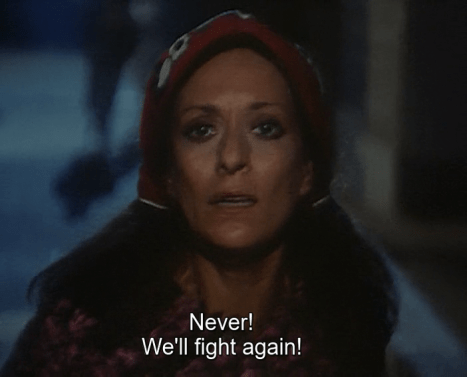
Finally, there is the most symbolic character of all, Bahiyya, the mother of Fatima. A character full of life, of smiles, liked by every other character in the film. Her presence onscreen is always accompanied by folk songs comparing Bahiyya to the Motherland itself. No mistaking here: for Chahine the character of Bahiyya is the very spirit of Egypt. This is only reinforced in the film’s iconic ending. The Sparrow was banned in Egypt, perhaps superficially for the remarkable Freudian sex scene between Raouf and Fatima, but more likely for its negative diagnosis of problems within every aspect of Egyptian society. Yet, this iconic final sequence has such a legacy that any Arab cinephile would know it even today. After the TV announcement announcing the defeat, which comes as a total shock to everyone watching, followed immediately by Nasser’s resignation from political life, Bahiyya viscerally rejects the announcement, her entire body taken over by an impulse, a populist impulse to run into the streets, to resist, to shout, to refuse defeat, to promise to keep fighting. Eventually, crowds follow her, and she reminds us of the Liberty leading the People in Delacroix’s painting, but it is tragically all in vain, all is already lost, the war, the territories to Israel, the idealism & pride brought by Nasser’s rule, the hopes of Pan-Arab strength and unity… It too is all lost. Not even the strength and purity of Bahiyya’s spirit can resuscitate any of it. Bahiyya has been betrayed and Chahine has given us a two-hour treatise up to that point, outlining just some of the reasons why.
Past and present rhymes
The media’s filtered propagandistic announcements over the first 5 days, claiming that the war is being won, completely blindsided the populace. Once the realisation of defeat hits them so suddenly, and after such a brief resistance, in a way this speaks to a precursor of fake news, the lack of democracy, of free press, of truth. It is impossible to re-watch The Sparrow today, with not 5 years distance but more than 50, and not think ruefully of how the same histories rhyme with each other. Impossible to not think of the Arab Spring or the 2013 Egyptian protests, of the same battles for democracy, or of a documentary like The Square (2013) the makers of which no doubt had absorbed Chahine’s The Sparrow and its lessons when telling their story of a more recent popular betrayal. The fights go on, but as Chahine was already teaching us half a century ago, the corrupt elites are not only lying to the people if they think they can go on forever like this, they are lying to themselves.
 Cinescope
2 thoughts on “The Sparrow (Youssef Chahine, 1972)”