
This article is part of My Faves of 1995, a series where I revisit some of my favourite films from that year. 1995 marked cinema’s centenary, but also a crossroads: poised between the end of the celluloid era and the dawn of digital, between Cold War geopolitics and a more globalised cultural map, a time when Hollywood indies and world cinema gems flourished side by side in ways they rarely do today. It also marked the first year of my burgeoning cinephilia, though I was far too young to catch most of these films on release. In this series I highlight the works that left their mark on me, why they’re worth (re)discovering, and why they still matter three decades later.
The White Balloon
Director: Jafar Panahi
Year: 1995
Country: Iran
I’ve written before about the thrilling moment that the wave of Iranian cinema in the 1990s represented, but many of these gems of world cinema merit a closer look. By the mid-90s Iranian filmmakers like Abbas Kiarostami, Mohsen Makhmalbaf and his daughter Samira, seemed to be redefining what cinema was and could be.
Part of the excitement came from the element of surprise: how could Iran, a global pariah since 1979, so often caricatured in the West as nothing but baying mobs, emerge as the source of such poetic, humanist cinema, the kind that made cinephiles worldwide fall in love with film all over again? I often recall a quote from American critic and programmer Richard Peña in Cineaste magazine stating that Iranian cinema had “returned the world to us”. I think I understand his sentiment, but which world? And who is this ‘us’ it is returning to?
In summer 1995, when I was nine, I made my first visit to Iran. I met an aunt and many cousins, was welcomed with warmth and hospitality, learned about classical poets like Ferdowsi and the cultural pride they inspired, and still remember the taste of traditional Persian ice cream. Implicitly, I also realised Iran was far more than the image presented to us in the West, and that the boundaries between ‘us’ and ‘others’ were never simple — though I was too young then to articulate it. That same year, Jafar Panahi, formerly Kiarostami’s assistant on Life and Nothing More, released his debut feature The White Balloon. I first saw it a couple of years later on British TV, finding it a cute and charming children’s tale. Today I see something more, an allegorical film quietly asking who counts as ‘us’ and who as ‘other,’ a subtle critique of who is seen, who is heard, and who is ignored. Thirty years on, as Panahi’s three-decade career of socially engaged cinema has this year been rewarded with the top prize at Cannes for his latest film, It Was Just an Accident, it is the right moment to revisit where it all began.
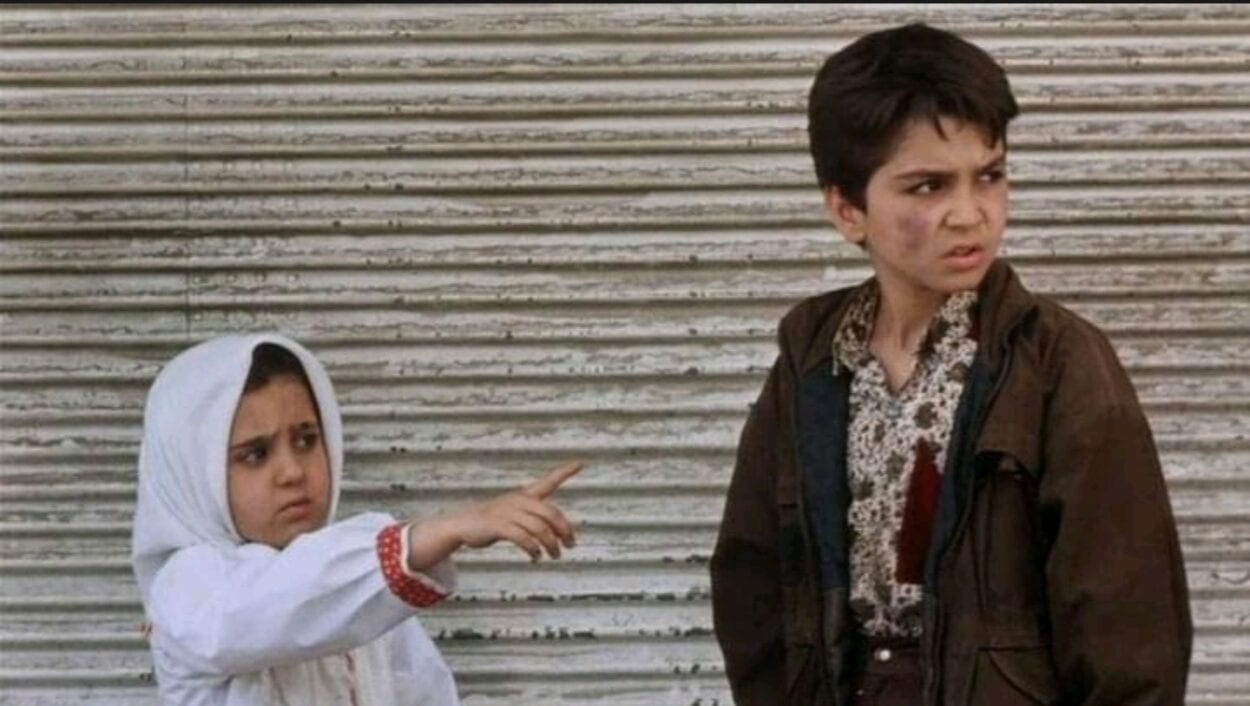
Panahi’s The White Balloon seems the simplest of tales: a little girl, Razieh, wants a plump goldfish for the traditional Persian New Year celebrations. Her family already has a pondful of them, but she insists the ones she wants are prettier and livelier. With her mother reluctant, she conspires with her brother Ali to get hold of a banknote and heads out alone into the bustling streets of Tehran. What unfolds is a miniature quest narrative, filled with detours, setbacks, and sudden obstacles, yet infused with a poetic eye for detail that encourages us to be active viewers.
Panahi, like his mentor Kiarostami, trains us to watch carefully, to enjoy the act of looking. Throughout, both Razieh and the camera shift their gaze down visual detours: a shop window, a cake in a display case, a fish shimmering in a bowl on a neighbour’s window sill, a narrow alleyway. As in Where is the Friend’s Home?, everyday sights take on a luminous intensity. We feel the wonder and danger of her walking alone amid the New Year celebrations, being jostled by crowds around a snake charmer’s performance, and almost hustled out of her banknote. We watch Razieh peering through windows and doorways, sometimes able to see without hearing, sometimes able to hear without seeing. We hear her father’s voice barking orders from offscreen but never see his face. Each encounter magnifies her smallness in an indifferent adult world, yet Panahi films with patience and good humour, encouraging us to share not only Razieh’s perspective but go beyond it, deciphering the frame for clues into an adult world of rules and restrictions she can only half-understand.
One of Panahi’s most poignant touches is the introduction of characters who, like Razieh, are outsiders. A lonely soldier on military service tells her he has no friends in Tehran. Later, a young Afghan refugee selling balloons appears, hovering at the edges of the narrative until the very end. These outsider figures remind us that Iranian society is not monolithic, it is layered with insiders and outsiders, and it is multi-ethnic as exemplified by this orphaned balloon seller who is but one of millions of displaced Afghan refugees who fled war in the 1980s. Razieh may seem self-centred, unlike Ahmad’s moral mission in Kiarostami’s Where Is the Friend’s House?, but through her eyes we glimpse a city, and through the film’s narrative shifts Panahi gestures to issues far beyond her childish desire.
The film’s visual motifs had prepared us for this all along: looking through windows to see things in a different frame, re-seeing, reconsidering, re-framing. By the end of the film, everything is re-framed. When Razieh loses her note down a sewer grate, it is the Afghan balloon seller who helps retrieve it. Yet when Razieh and her brother finally dash off to buy the fish, they leave him behind without a thank-you or even a glance. But Panahi and his camera do not. For the final minutes of the film, unexpectedly we lose Razieh and her perspective. The film ends centred on this orphaned Afghan boy, lingering on him left completely alone for what seems a surprisingly long time. The title, we now realise, refers not to Razieh’s balloon but to him. By now, we conceptually re-think everything we saw, Razieh’s sweetness as stubbornness and spoiltness, her determination to buy a goldfish as pointless desire to always have something ‘shinier’ and ‘newer’, her status as an outsider only temporary unlike the more permanent outsiders she has met, the father’s shouting offscreen as subtle shades of patriarchal violence, and so on.

It may or may not be that Panahi was inspired by Kiarostami to use this oblique narrative strategy; Kiarostami had used it many times, even as far back as in his very first short, Bread and Alley, which shifts focus deliberately from a young boy to a hungry stray dog. Either way, there is a long tradition of such shifts in focus rooted in Persian culture, where classical poems told of quests that end with an unexpected discovery rather than the object sought. We are the ones who have gone through this quest, at the guidance of Panahi, while Razieh may have acquired a new goldfish but lost a life lesson.
Thirty years on, Panahi’s debut remains an enchanting portrait of childhood: the curiosity, the desires, the small terrors and joys of venturing into the world. But beneath that it is a parable about looking — about who we notice and what lies just outside the frame. It stands alongside the conceptual core of a more recent, and very different film, Jonathan Glazer’s The Zone of Interest, by challenging us to question how we consider what we do not see? Whose stories do we overlook? Whose presence do we take for granted? Why is there an ‘us’ we focus on and a ‘them’ we neglect to see? The White Balloon is a fable about vision and attention that remains as charming on the surface and as relevant in its subtext, a call to look again, more carefully, at our lives, our societies, our world. (September 2025)
 Cinescope
One thought on “The White Balloon (Jafar Panahi, 1995)”