
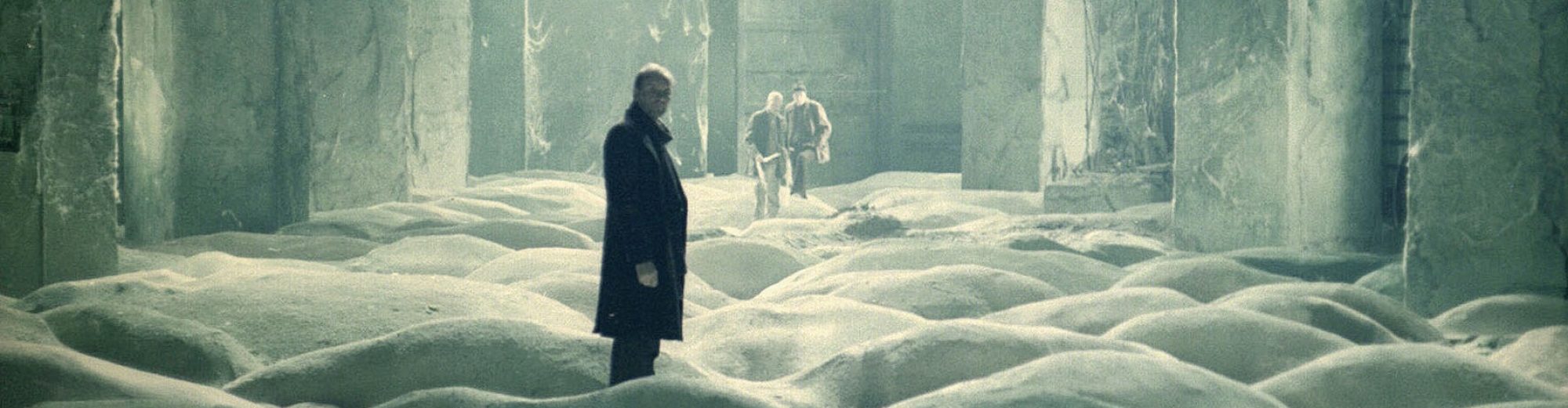

 Edvard Munch
Director: Peter Watkins
Year: 1974
Country: Norway/Sweden.
Far from feeling like a stylistic gimmick, this invisible “camera crew” embedded within a late-19th-century Norway (and at times Paris, or other major European cities as Munch travels) deepens our immersion in Munch’s life and milieu. By staging bohemian artists, anarchist intellectuals, and scandalised conservative critics as though they are being observed and confronted by present-tense reportage, Watkins collapses the distance between past and viewer. Scenes gain an immediacy that no conventional costume drama or museum-safe biopic could hope to match: arguments over art feel vital; glances to camera feel as if utterances might have real political consequences; the fog of cigarette smoke, the clash of ideologies, the raw emotional tenor of Munch’s inner circle all feel unsettled and alive. Quite simply, Edvard Munch is one of the most idiosyncratic and successful of biopics, a genre I have complained about before.

Watkins’ approach to his material here is also faithful to Munch’s artistic sensibility. Many of the artist’s portraits confront the viewer directly (e.g. see poster above), figures staring out from the canvas with expressions that feel at once accusatory and exposed. Watkins mirrors Munch’s psychological directness and emotional rawness onscreen, most strikingly in scenes featuring Munch’s sister Inger, who fixes the camera with the same penetrating gaze she directs toward the viewer in Munch’s deeply personal painting Death in the Sickroom (see below). That painting, like Watkins’ film, summons the spectre of tuberculosis — disease that claimed both Munch’s mother and his beloved sister Johanne Sophie — and treats looking itself as an act charged with memory, grief, and moral weight. By adopting a form that invites, even demands, that historical subjects look back at us through the camera, Edvard Munch crafts a visual language that honors Munch’s own, allowing the film to operate simultaneously as biography, as living archive, and as critique (of the artist, of his world, and of the media as filtering window).

Covering the years 1884 to 1899, wtih intermittent flashbacks to the sickrooms and terrors of Munch’s childhood, Watkins reconstructs the most formative and artistically explosive period of the painter’s life through image and sound. The film layers audio in ways that mirror the workings of memory: sound bridges carry the emotional residue of one scene into the next; fragments of dialogue or ambient noise bleed across temporal boundaries; future events seem to leak into the present before we fully arrive at them, as though the past cannot be contained within its chronological boxes but instead reverberates restlessly — much like the traumas that shaped Munch himself and that he etched onto his painting. And the sound of that too is given prominence, with one of the film’s most memorable, tactile sounds being the rough scrapes of Munch’s brush and palette knife against canvas. This textural element gives us intimate proximity not only to this past world brought back to life through spoof TV crews, but also to Munch’s working process and his inner world.
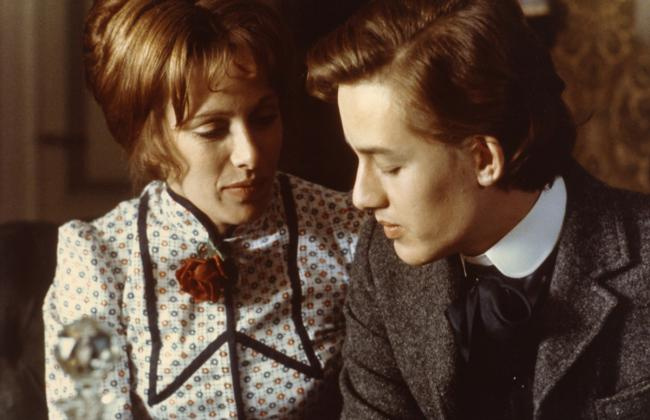
A significant portion of the film centres on Munch’s early affair with an older, married woman, portraying the raw emotional intensity of this young artist, at times almost a proto-emo, which bleeds onto his expressionist art and of course the film itself. The emotional and the internal are just as important as the wider context. Watkins cuts rapidly between scenes of romantic ecstasy and images of sickness, decay, and spiritual terror to relay the upheavals and traumas of Munch’s lived experience. In interviews and essays, Watkins criticised traditional art history for a fixation on stylistic lineage at the expense of psychic and personal catalysts. Edvard Munch thus acts as a corrective, a work that strives to be conceptually, sensually, and emotionally rich.
At first glance Edvard Munch is by no means as directly political as the film Watkins made just prior, Punishment Park (1971), a blistering, pseudo-documentary nightmare that imagines America turning dissenters into hunted fugitives in the name of “law and order” and a vision which seems less and less far-fetched as it ages. But even if he delves deep into Edvard’s soul here, Watkins, ever a filmmaker of profound intellectual curiosity, also situates Munch’s torment within a wider socio-political frame. The film draws a close parallel between Munch’s struggle to express himself artistically and his struggle to exist within a hypocritical, morally repressive society. His inner turmoil becomes inseparable from the contextual turbulence around him, the rapid industrialisation, the widening inequality, the political debates, and the brittle pieties of bourgeois respectability. Munch’s canvases, haunted by existential dread most iconically exemplified by ‘The Scream’, are not merely private confessions but also articulations of collective anxiety for the future. Watkins suggests this through a mosaic of references to looming world events whenever the timeline shifts, framing Munch’s paintings as prophetic premonitions of the 20th century: 1889, the birth of Hitler; 1898, the U.S. annexation of Pearl Harbor following the Spanish–American War; and so on — the only other work I can recall achieving such a panoramic tapestry of narrative and historical allusions, of biography and diagnosis, as successfully would be Alan Moore’s graphic novel From Hell (not the film of course, a tepid, hollowed adaptation which only confirms Watkins’ diatribes about the lack of ambition in mainstream filmmaking).
Filmed on location, sometimes even inside Munch’s actual childhood home, and performed by a large ensemble of non-professional actors whose resemblances to their historical counterparts are uncanny, Edvard Munch achieves something staggering: a dense, living mosaic of history and art unfolding before us as if in real time through the device of its ‘live TV crew’ filter. The dialogue fuses Watkins’ script with improvisations and excerpts from Munch’s unpublished diaries (to which Watkins had privileged access), collapsing past and present into a single continuum, reminding us that we are watching multiple histories at once — the life of Munch in the late 19th century, the reenactment of that life by and through people in the 1970s, and whatever era we re-watch the film in now. For whatever era we watch it in, the film (and pretty much all of Watkins’ films) will still speak to us, haunted as it is by universal questions of identity, suffering, repression, and self-expression. It achieves a perfect marriage of content and form, honouring the core principle of expressionism itself, namely that artistic authenticity lies not in faithfully reproducing the world but in expressing the emotional and existential truth beneath appearances and projecting that back onto our world for us to witness. The great Peter Watkins may have left us, but his films remain as ‘live’ and as alive as ever.
 Cinescope