

“Although I may seem the same to other people, to me each thing I produce is a new expression, and I always make each work from a new interest. It’s like a painter who always paints the same rose.”
“Someday, I’m sure, foreigners will understand my films. Then again, no. They will say, like everybody else, that my films aren’t much of anything.”
Born: 12 December 1903, Tokyo, Japan.
Died: 12 December 1963, Tokyo, Japan.
Directing Career: 1927 – 1962.
Movement: ‘Golden Age’ of Japanese Cinema.
Traits: One of the most distinctive directors in Japanese cinema or film history, Ozu’s style can be immediately recognised for his typically stationary camera filming his characters from a low-angle, his meditative still-life shots transitioning between scenes, his eschewing of traditional continuity editing, his elliptical narratives, and his visual playfulness. Despite a few early genre films ranging from slapstick comedy to gangsters, his theme has predominantly been a chronicle of Japanese society in transition with a particularly poignant awareness of the flow of life, the inevitability of change, and the strains of parent-child relations as generations move on.
Collaborators: Setsuko Hara (actress), Chishu Ryu (actor), Kogo Noda (writer), Yuharu Atsuta (cinematographer), Tatsuo Hamada (art director), Yoshiyasu Hamamura (editor), Tadao Ikeda (writer), Haruko Sugimura (actress), Kuniyo Miyake (actress), So Yamamura (actor), Takeshi Sakamoto (actor), Choko Iida (actress).
Related Directors: Mikio Naruse.
1936
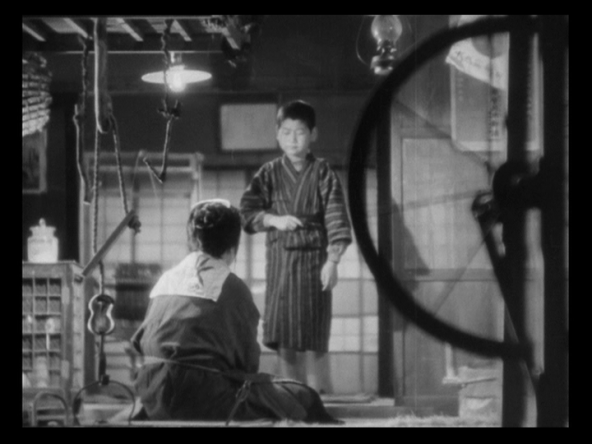
 The Only Son
“Life’s tragedy begins with the bond between parent and child”
— Ryunosuke Akutagawa
One evening in 1923 in a small rural Japanese town, after her day’s shift at the local silk factory, a widowed mother (Choko Iida, one of Ozu’s stock actresses) makes a promise to her only son: she’ll do whatever it takes to pay for his education into secondary school, be that more slavish toiling and even sending him away to board in Tokyo. All she asks in return, she underlines, is that he makes all this worthwhile by becoming a ‘great man’.
Cut to thirteen years later. 1936 is a seismic year in Japanese history. The country is suffering from unemployment and other economic repercussions of the Great Depression. The 226 Incident, a failed military coup (an event dealt with in cinema several times, explicitly in Gosha’s Four Days of Snow and Blood, more abstractly in Mishima’s Patriotism and Yoshida’s Coup d’Etat, and in the background of Oshima’s In the Realm of the Senses), ends up strengthening Japan’s militarist factions, enabling them to push more aggressively for expansionist policies in the Emperor’s name. The Anti-Comintern Pact is about to be signed with Nazi Germany. None of this deeply significant history of 1936 in Japan is stated in the film, but it’s there in the Japan Ozu is depicting, a Japan where those left behind by the state’s failed promises of modernisation and monomaniacal focus on warmongering have no chance of catching up.
The mother, now working as a cleaning lady after the economic crisis devastated the textile industries, has even been forced to sell her home. To her coworkers she brags proudly of her son, now in his mid-twenties, and the success she believes he has achieved. She is totally unprepared for what she finds when she makes a surprise visit to him in Tokyo. It’s not only that he has a wife and a baby son he has never mentioned. More disheartening is that he scrapes by as a night-school teacher on slim wages, rather than the more prestigious jobs the mother had envisioned. He lives on Tokyo’s margins, in a drab suburb overshadowed by a garbage incinerator. The mother speaks of all the fancy sights her son takes her to on her trip, but Ozu never shows them to us — that’s not the Tokyo he’s interested in depicting here. Instead we see an expanding periphery of crowded, joyless lives, where fierce competition for work leaves most facing that most Ozu-esque of realisations: the inevitably disappointing disparity between expectation and reality. A sacrificial mother who sends her son to study in Tokyo is no guarantee that he will ‘make good’.

So the realisation hits home in this film of Ozu-esque quiet epiphanies: the son has failed in his professional life. But he has succeeded in his personal one. He is not a ‘great man’, but a good one. He is a kind, generous man, and a giving father and husband. But is that enough for the mother? Stuck in her lonely life miles away from her son, she does not even have the consolation of gaining prideful satisfaction from her son’s social status. The son himself has feelings not just of disappointment but of guilt, the guilt that indebtedness brings when we feel unworthy of the offering awarded us. Consequently, the son feels he owed his mother a greater return for her sacrifices. This no doubt has much to do with him being an only child — compare and contrast with the lack of filial obligation felt by the siblings in Tokyo Story as they pass their elderly parents among each other like an unwanted burden, but a burden they can at least distribute between the five of them. Not many films made anywhere in the world in 1936 feel so true in their unsentimental awareness of human lives — Mizoguchi’s two masterpieces made that year, Osaka Elegy and Sisters of the Gion being among the few rivals.


But to watch The Only Son is also to witness that ‘Ozu touch’ being perfected, after several sporadic appearances in an already long list of films. It is there in the way Ozu introduces scenes with his playful associative chain editing, linking shots by cutting to a different view of an object we saw in the previous one, engaging us in a fun game of trying to guess where he’ll take us to next and what will link the two shots. It’s there in the two pivotal conversation scenes between mother and son, filmed from his trademark angle and height — while Mizoguchi’s masterpieces positioned his humans at a distance from us and often behind doors and sliding screens, Ozu puts his at the forefront and centre of the frame in medium shots. Finally, it’s there in the contemplative closing shots suggesting the melancholy inner life of the mother, undercut by a jaunty tune on the soundtrack — the bittersweetness of life that nobody could convey quite like Ozu. (July 2018)
 Cinescope