
The President’s Cake
Director: Hasan Hadi
Year: 2025
Country: Iraq
I went into The President’s Cake at the London Film Festival knowing no more than a one-line synopsis, but came out feeling I might have stumbled upon a potential major new voice in contemporary Arab cinema, first-time director Hasan Hadi. Set in 1990s Iraq, shortly after the First Gulf War and amid the suffocating years of international sanctions, the film opens with a seemingly harmless school ritual repeated each year across the country before President Saddam Hussein’s birthday: a classroom draw to decide which pupil will bake the ‘honorary’ cake for the celebrations. This is no lottery anyone wishes to win; Saeed, a boy who arrives late to class, is punished by his overzealous teacher by having to enter his name five times into the draw. He ends up taking the ‘runner-up’ prize of providing the fruits for the celebrations, but the unlucky ‘winner’ is a nine-year-old girl, Lamia, the film’s lead character.
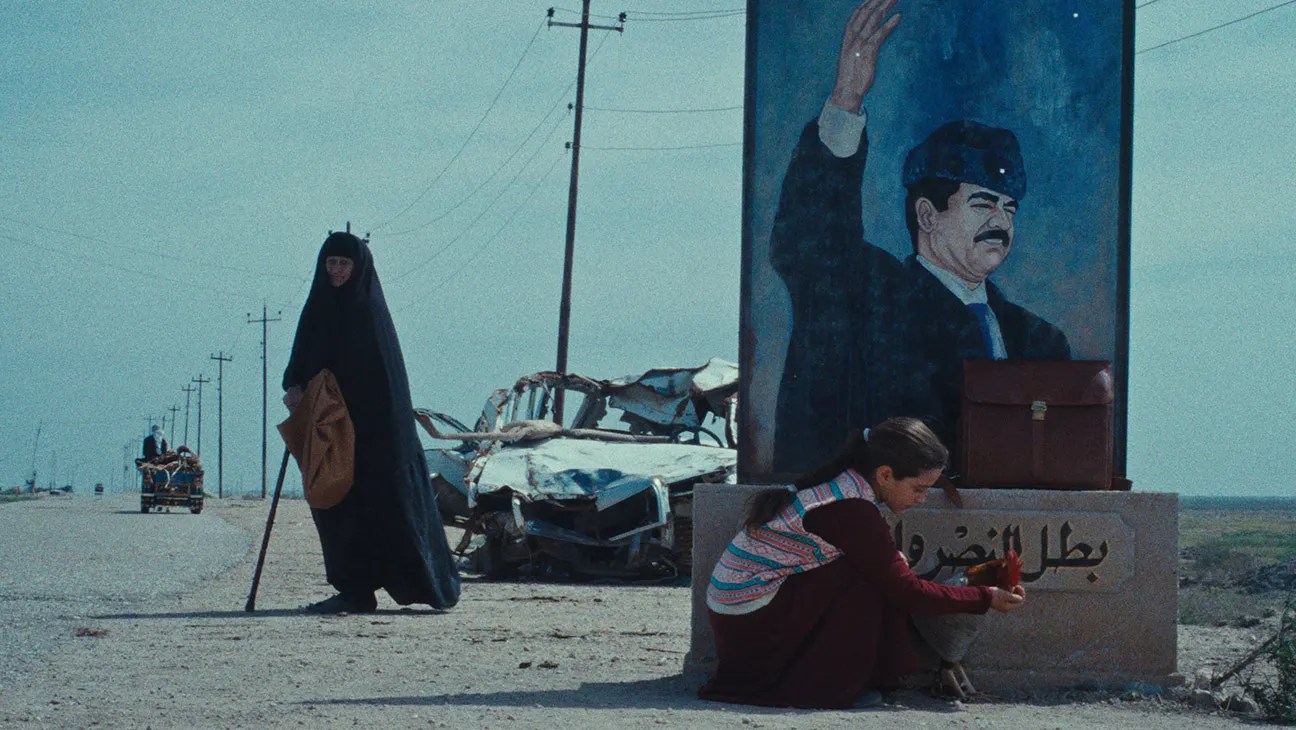
Lamia must gather flour, sugar, eggs and baking powder in a country where international sanctions, hurting the general populace far more than they ever did Saddam and the regime, have made such things scarce luxuries. Here we see the absurdist aspect of the film’s premise, which is to say of life itself in 1990s Iraq: Saddam’s cult of personality forced a nation that was being starved to bake cake for him and, the cherry on top of it all, to be grateful for the honour of doing so. Refuse or fail and the schoolteacher reports you and your family to the authorities as people who don’t love Saddam, a most serious crime punishable by jail, torture, maybe worse. The grip Saddam has over everyone is palpable, in his omnipresence not only through posters everywhere, or endless television coverage, but also in the minds of people through weaponised fear. At one point, Lamia cuts Saeed mid-conversation with the rebuke “walls have ears.” It’s a warning that must have echoed through every Iraqi household of that time, and a phrase I remember being whispered in response to my naive questions by my relatives during summer trips to Baghdad in the 1990s. Even as a child, I could sense that fear of neighbours reporting on each other, turning Saddam into a boogeyman who was everywhere but could never be spoken about aloud.
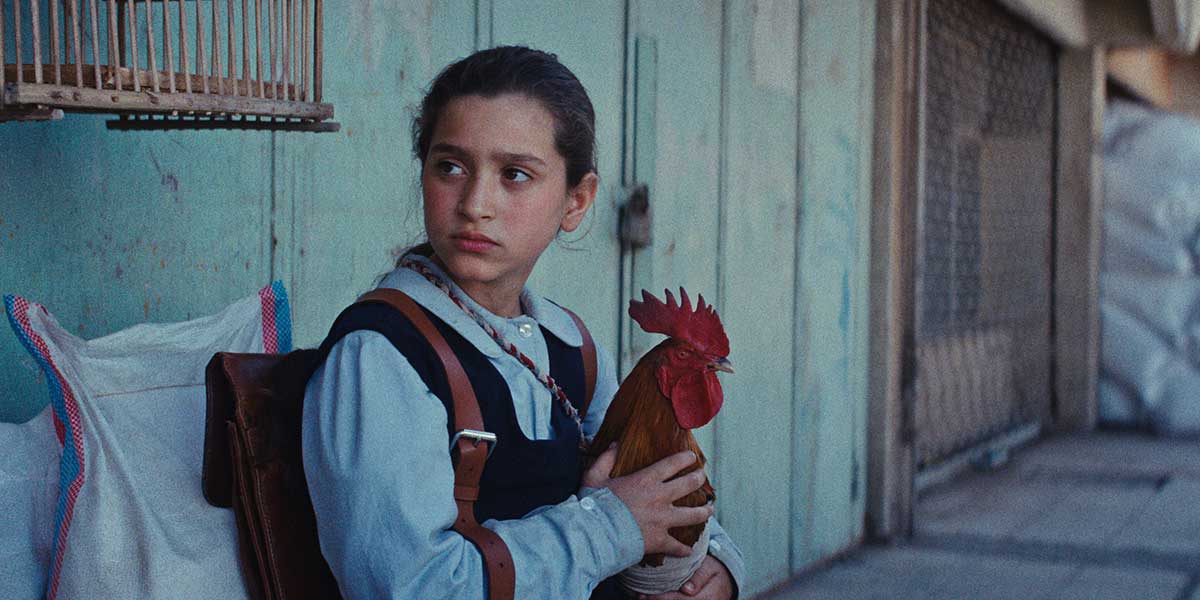
So accompanied by her grandmother, her beloved pet rooster Hindi and, eventually, her classmate Saeed, Lamia’s search for ingredients is an odyssey through a country hollowed out by dictatorship, corruption, and deprivation. Obvious comparisons can be made with the New Iranian Cinema’s child quest narratives, like Kiarostami’s Where is the Friend’s Home? and Panahi’s The White Balloon, and their depiction of resourceful children perservering in a world of adults. But there is something less allegorical and more direct about Hadi’s treatment here, partly down to the explicit reference to Saddam; his downfall means films can now be refer to him in ways that Iranian cinema cannot of their own dictatorship. There’s also a darker edge than the Iranian childhood films could ever get away with. The moral corruption which the sanctions and the dictatorship have create in Iraqi society seeps through every scene, creating the vista of a dog-eat-dog world where people have been reduced to their most primal urges, ready to exploit anyone weaker for food, sex, or money. From the soldiers, to the police officers, to the schoolteacher who threatens to report the children, everyone is a mini-Saddam in this hierarchical depiction of how dictators rule by proxy with ground-level ‘representatives’ taking it out on everyone below them.
Another set of influences are perhaps even more telling in explaining the film’s darker tone. Several key crew members, including the editor, the production designer, and the cinematographer, are Romanian and have worked with the likes of Cristian Mungiu and Cristi Puiu. There is something of the lucid realism and dark absurdism of the Romanian New Wave’s view of failing social systems through a tragicomic lens. What Hadi and his crew create is a whole panorama, rather than only an allegorical fable centred on a child’s quest. Power relations are in every frame, whether policemen berating peasants from rural Iraq or a soldier in the background of one shot forcing a woman into his tent for what we can assume is forced prostitution. Then, there’s the film’s most chilling sequence, almost unbearable in its limpid style, no music, slow camera movement dragging things out so that we pray from the edges of our seat that Lamia will escape when a seemingly kind butcher tries to lure her into a sexually predatorial situation with false kindness. These moments could be out of Mungiu’s perfectly timed social-thrillers like 4 Months, 3 Weeks & 2 Days or Puiu’s tragicomic sociological exposés like The Death of Mister Lazarescu.
But Hasan Hadi’s instincts are already savvy enough to make these sources his own and, finally, the film is genuinely Iraqi in content and form whatever the influences. Firstly, there is the key setting of Iraq’s southern marshes where Lamia lives and goes to school. This ancient landscape of reeds and water that was once called the cradle of civilisation has inspired both the Epic of Gilgamesh and classic 20th century Arabist texts like Wilfred Thesiger’s non-fiction travel book The Marsh Arabs. The film’s stunning first shot opens onto dawn and tranquility in the marshes, canoes slaloming around houses built from reeds in what could be the 20th century BC as easily as it could be the 1990s, at least until two jet fighters pierce through the sky, one even doing a pirouette maneuver. Beauty, history, and military menace co-exist in one opening shot visually encapsulating the tragedy of modern Iraq.
It is gorgeous, timeless, and picturesque as a setting, but is no mere exotic backdrop. Hadi’s choice of the marshes, which after 6000 years of of unbroken habitation were drained, devastated and almost destroyed by Saddam’s regime in the 1990s in punishment for the marshes’ residents supporting anti-government uprisings, gives the film a hefty thematic undertone. It’s there in the film’s Arabic title, mamlakat alqasab, the Kingdom of Reeds, which refers poetically to these wetlands but also to a perishable domain that can crumble at any moment, whether that means the world of the marshes or Saddam’s regime. Yet, despite Saddam and despite the ongoing threat of climate change, the Iraqi marshlands have been rebuilding in recent years, and feel like a hopeful metaphor for a post-traumatic nation that endures.
At the London Film Festival screening’s Q&A session, many audience members of Iraqi origin were visibly emotional and thanked Hadi for creating a representation of a time that still leaves many emotional and physical scars. Hadi himself spoke of growing up in Southern Iraq in that era, of being raised by strong women who gave him a different gaze on power and patriarchal society, and of the hope that infrastructure and industry for filmmaking will be developed to allow an Iraqi cinema to go beyond the individual endeavours of a few committed filmmakers like Mohamed Al-Daradji or Abbas Fahdel. Iraq’s painful past is also a wellspring of stories to be digested and learnt from as the country rebuilds towards a hopefully more stable future. The President’s Cake is a film about survival, of Lamia, of the marshes, of a nation under siege, and also of memory itself. Watching it this year, it’s hard not to think of the genocide in Gaza, another instance of civilians bearing the brunt of political cruelty while the international community complicitly watches on. Hadi has made a feature both harrowing and engaging, finding moments of light and beauty in his vista of social darkness, in the act of baking something sweet in a bitter world, and I hope he will make many more.
 Cinescope