Palestinian History on Film: Leila and the Wolves (Heiny Srour, 1984)

This essay is part of CineScope’s ongoing series on films that challenge the erasure of Palestinian history. From time-travelling mosaics to archival counter-histories, these works resist silence and restore memory. You can read more in the series here and find my original newsletter introducing the series on Substack here.

Leila and the Wolves
Director: Heiny Srour
Year: 1984
Country: Palestine/Lebanon.

“You’ll go down on the wrong side of history.” Heard this phrase before? It’s one we love to use, to invoke as if some day in the hopefully-not-too-distant future all events will be filed into the right (or wrong as it may be) historical category. A sort of secular, historiographical equivalent of the Last Judgment. But who on earth will get to make this reckoning? And why do we trust that the moral compass of this consensus will be any more neutral than today’s? As Gerald Nesmith Jr argued in an Al-Jazeera op-ed, this phrase is essentially used to comfort us, with the idea that moral clarity will one day arrive, but it is in fact an illusion. For example, when will the USA, a nation built on settler colonialism, slavery, genocide, and imperialistic meddling in other nation-states’ sovereignty, be filed on the “wrong side of history”?

Worse still, this utopian idea that some more enlightened future will categorise ‘right’ and ‘wrong’ more sharply and nobly than we could is not just an empty threat to deaf ears, it’s also implicitly a way of kicking the can down the line in the hope that today’s problems will be sorted by posterity. No, history is no neutral judge. As another familiar phrase reminds us, it is written by the victors, by power and institutions, by those who are loudest, and overwhelmingly by men. If the people most harmed, most erased, and most silenced are no longer present in any archive or any memorial, then how will the wrongs committed one day be sentenced by future historian-judges? The great Arab-Jewish-feminist filmmaker Heiny Srour, herself too little known, made a wonderful film called Leila and the Wolves (1984) which offers a response to this, one both politically and artistically ambitious, and forming a defiant counter-history of Palestinian and Pan-Arab resistance in the 20th Century. One countering not just the ‘official’ version of events where Israel was a land without a people for a people without a land, but also the patriarchal erasures embedded within Arab national memory itself.

Image 1. Leila’s photography exhibition of archival Palestinian images.
Image 2. Leila and her fiancé Rafik, who dismisses the role of women in history: “women had nothing to do with politics in those days”

The anchor of her film is Leila (Nabila Zeitouni), a Lebanese woman living in London, exiled from her country’s internecine civil war (1975-1990) which grew out of the Palestine-Israel conflict and exacerbated existing fractures in Lebanon. In London, Leila is organising an exhibition of historical Palestinian photographs from the pre-Nakba days (Image 1). These are vital memories in and of themselves, vivid snapshots of a past now forgotten, but which through omissions of their own imply a past doubly erased. When Leila shares to her Lebanese fiancé Rafik (Rafik Ali Ahmad) her observation that these images lack any women, he dismissively responds that “women had nothing to do with politics in those days” (Image 2), before returning to the topic he really wants to discuss: what he thinks she should wear on their wedding day.

On one level, the entire film after this functions as corrective to the fiancé’s claim, using Srour’s own research (itself building on collective work of other researchers, activists and counter-archivists such as Khadijeh Habashneh Abu Ali to name but one) and the stories she was told and heard. Srour translates these stories of women’s real-life experiences into a cinematic poem, in order to counter the invisibility of women from the archival photographs and the official staging of history, and does so through the unofficial sphere where it could live and be re-told: the spoken word of storytelling.

I: Down the Rabbit Hole (of History)

The film enters this mode in one sequence where, as the camera slowly circles around the exhibition space allowing us to see these incredible photos on the walls, the soundtrack suddenly unveils the voice of a storyteller: “Once upon a time…”. A poetic, Arabian Nights-inspired fable of invading wolves and olive groves in the historical lands of Lebanon and Palestine is spoken by an unseen woman, as the camera continues to revolve around what seems to be the empty gallery, its circular motion a visualisation of the cyclical, never-ending repetition of time’s horrors as we humans never manage to learn from history. Throughout this shot, the audio continues coming from offscreen, making us wonder who is speaking, and already hinting at the film’s interest in oral history, the importance of hidden stories within images. Finally, the camera reveals the storyteller to be present in the scene, an older woman sat on a prayer mat on the floor. Leila’s head lies on her lap, to be gently stroked while she continues her story (Image 3), as if this is her grandmother who has suddenly materialised in her gallery space and she is remembering what it feels like to be told stories as a little girl. The stories a grandmother might tell her granddaughter, the stories Srour herself saw and lived through, are not the kind of stories recorded by ‘official history.’

Image 3. Leila’s photography gallery suddenly turns into a chamber of oral memory and storytelling.

And so, from here Leila and the Wolves brings these buried histories to life by sending Leila on a time-travelling odyssey, a poetic mosaic of stories in which time itself refuses to behave. At one point 1920s Palestine leaks into 1970s Lebanon, at another Leila walks down a British Mandate street and emerges into a refugee camp after the Nakba, suggesting a repetitive cycle of oppression and violence. The film’s fragmented structure weaves archival footage, symbolic tableaux, and vignettes from different periods of history folding in on each other, to fuse together a revisionist, feminist historiography grounded in memory, storytelling, and intergenerational transmission. Framed by the long aftermath of 1948 and the Lebanese Civil War, Srour’s film traces how Arab women’s roles in political resistance have been systematically sidelined, by colonial forces as well as their own patriarchal societies.

II: Invisible Cities

The 1920s. Post-WWI Palestine, when the post-Ottoman Middle East has been carved up by France and Britain in the infamous Sykes-Picot agreement (the British took over the lands of Palestine, Jordan and Iraq; the French of Lebanon and Syria). British troops march triumphantly into Jerusalem, a radio broadcast (again, the importance of the film’s layers of sound) noting that Lloyd George had asked for the city as a Christmas present, and received it. But where there is the exercise of power, there is resistance. In the narrow alleyways of the Old City, we see a street protest chanting Palestine is Arab splintering into violence as confrontational British soldiers open fire. In the balconies above, however, another story stirs. The women, confined to their kitchens and rooftops, ironically have an advantage in vantage point, their domestic sphere becoming the resistance’s high ground above the city (Image 4). From up there, they hurl pots and jugs onto the advancing British soldiers, some even pouring boiling oil down onto them (Image 5). In these narrow streets which they know far better than do the British colonisers, the domestic confinement and neighborly coordination of these women becomes tactical elevation.

Image 4. The women’s domestic sphere becomes strategic high ground.
Image 5. Women play their part in defending the men being shot by British soldiers.

Yet Srour does not romanticise. Returning to one of these households, we find one woman who defended her street later being beaten by her husband for burning his dinner, threatened with the humiliating prospect of his taking a second wife. Her sister consoles her with survival strategies — recipes for better dishes, hot water for his feet, gestures of submission required to keep her place. In resurrecting this buried chapter of anti-colonial struggle and women’s invisible role within it, the film also exposes a second erasure: the persistent violence of patriarchy that fractured solidarity from within.

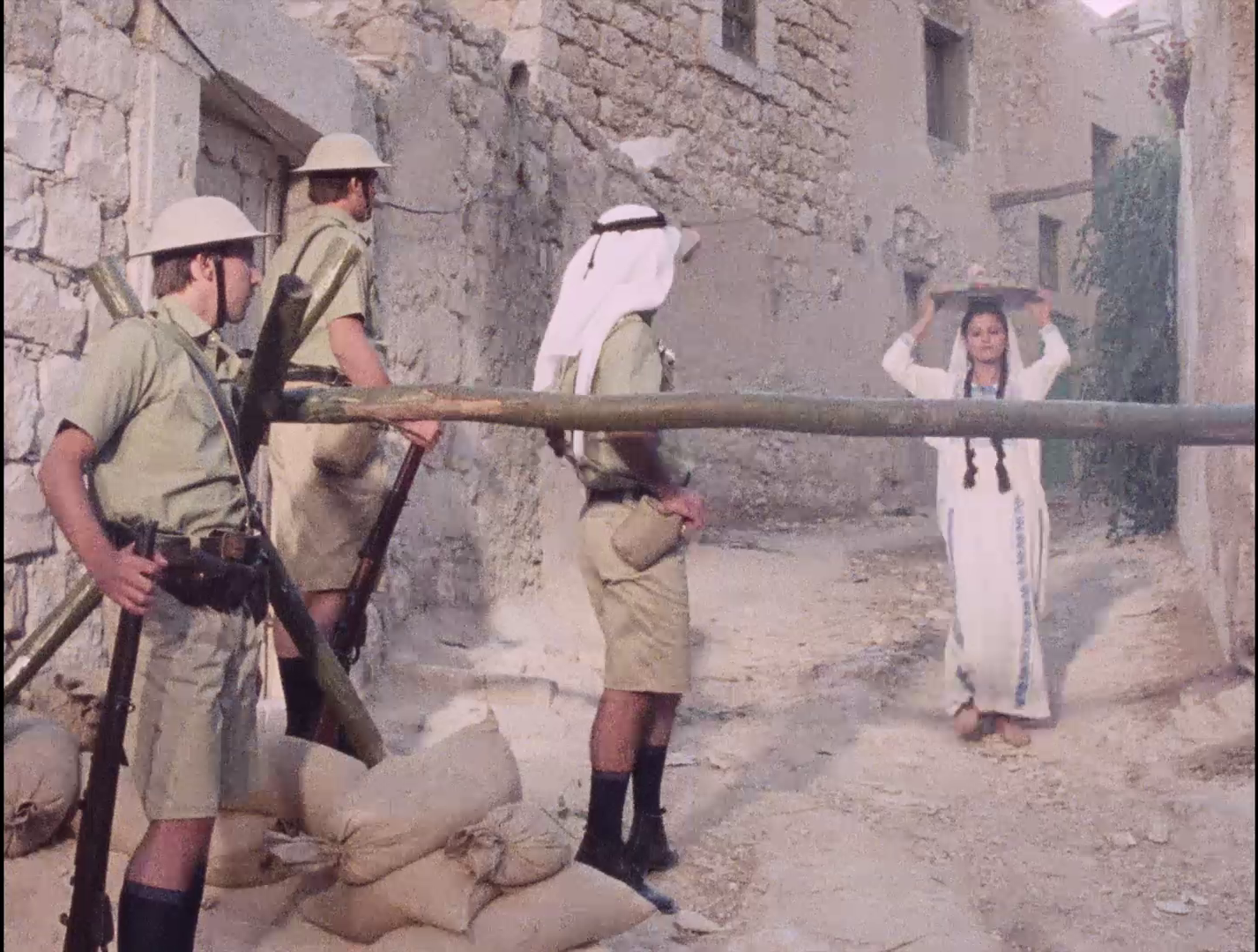
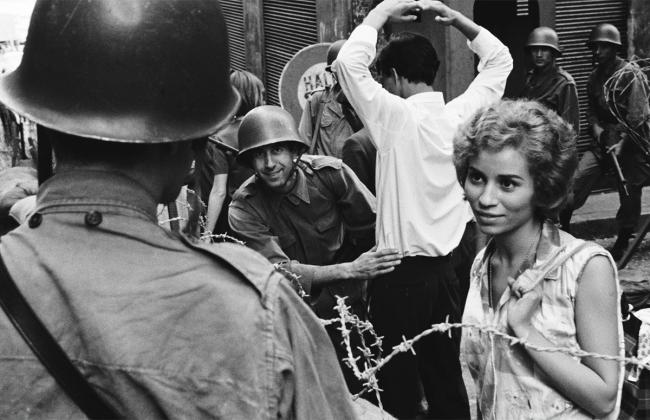
1936-39. The Arab revolt, recently brought to screen by Annemarie Jacir’s Palestine 36, when Palestinians rose against the British Mandate which saw them as barely to be concerned with, invisible in other words, in pushing ahead with its project of engineering a “Jewish National Home.” Srour includes archival images of British convoys and deserted streets during the six-month general strike which then dissolve into Leila herself wandering these same streets, as if is stepping through a temporal fissure. Here too, women have a role to play, being able to move freely across checkpoints (Image 6, creating resonances with another classic of anti-colonial cinema, The Battle of Algiers) under the pretext of organising a wedding, in which time-hopping Leila is the bride, the women ululating as they go, their songs carrying coded meanings only fellow resistance fighters understand. The lyrics can reaveal when the soldiers are coming, where the rifles are hidden, where the ammunition is stored, and so on. Pots of rice conceal guns, uncooked kubbeh hide bullets. Domestic labour transformed into insurgent strategy.

Image 6. In 1930s Palestine, Leila slips through a British checkpoint using her wedding as decoy. Women had more leeway to evade scrutiny, long before checkpoints became a defining feature of post-1948 Palestinian life. Below, a parallel moment from The Battle of Algiers (1966).

Image 7. The film’s restaging of the Deir Yassin massacre, 1948.

III: The Tale that Refused to Disappear

1948. The Nakba. The Deir Yassin massacre, where Zionist paramilitary groups, the Irgun and the Lehi, their black uniforms already signalling the fascist ideological lineage they carry, massacre more than a hundred Palestinian villagers, women and children among them. It comes to stand as a microcosm of the Nakba in the film’s representation, one of the many original sins upon which the newborn Israeli state is created, one that history is yet to judge decisively, since similar violence has long continued.

Srour stages Deir Yassin not as distant historiography but as shattering, lived moment. One lone woman courageously with all the energy left in her urges her neighbours not to die meekly, wrests a rifle from an attacker (Image 7), and briefly reverses the balance of power, until another paramilitary cuts her down before she can pull the trigger.

What follows is a mosaic of annihilation, showing Srour’s influence from Soviet montage and Third Cinema alike, where fast, rhythmic cuts yoke together the black silhouettes of the paramilitaries with the executed villagers’ blood-red-on-white garments. Then the tempo eases into a long lament, the camera drifting across corpses, shattered walls, a landscape newly emptied. That collective wound is extended beyond the one village of Deir Yassin through the use of actual UNRWA archive film showing the dispersal of families piled into trucks, others fleeing on foot, the transformation of an entire population into refugees.

Image 8. Leila drifts like a lost soul in a Beirut ravaged by war and killing, but still haunted by sonic memories of happier pasts.

IV: If Ruins Could Speak

1975. Post-1967. Post-Black September. Many refugees have now turned into fedayeen guerrilla fighters, understanding that nobody but themselves can fight for a fairer future. The Palestinian struggle has migrated northward, echoing the Pan-Arab belief that the fates of Palestine and Lebanon are inseparable. Once again, women are far from being “uninvolved.” They refuse to stay in the margins and undergo guerrilla training. But in what is a common motif throughout the film, the resistance meets resistance from within. Many look down upon those women who do join the fedayeen, including other women, and warn that any woman joining the struggle risks ostracisation and that most feared-of threats, their husbands taking a second wife. In one bitter vignette, the fedayeen men, supposedly revolutionaries, weaponise patriarchy to police their wives’ participation, revealing that the fight against occupation is entangled with another, older struggle at home. The more things change, the more they stay the same.

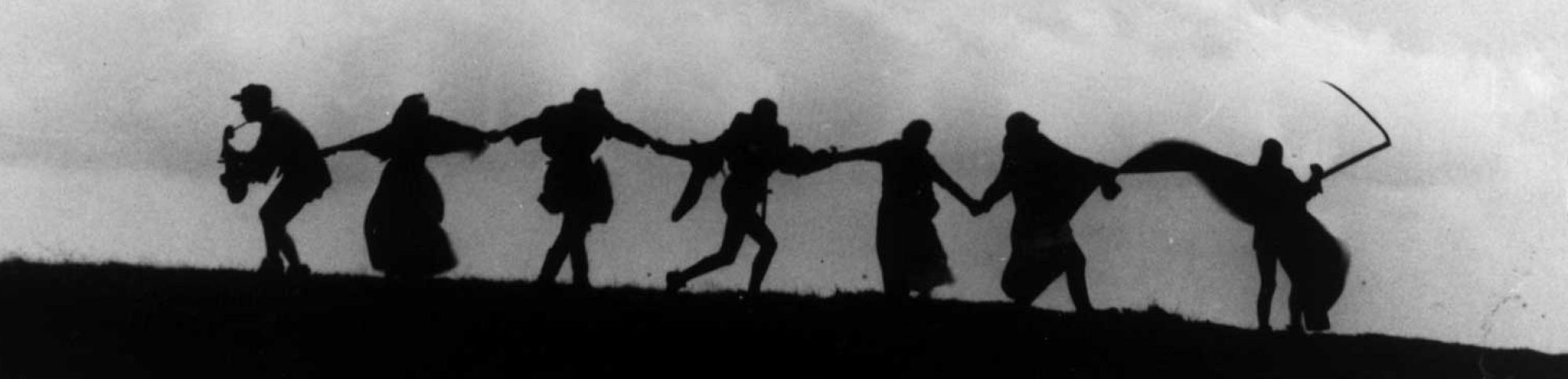
The film’s tone darkens as it absorbs the devastation of the Lebanese Civil War and the terror of this neverending bloodshed — after all, though it does not explicitly refer to them, the film was completed in the wake of the massacres at the Sabra and Shatila refugee camps, which haunt its final mood up to the danse macabre between Leila and cassock-cloaked skeletons in another circular, cyclical choreography of Time’s deathly toll. Before this, Srour gives us shots of our guide Leila walking through destroyed Beirut streets, entire buildings hollowed out by bombs, the cityscape cratered into an urban necropolis (Image 8). The film’s signature slow, circular camera movement drifts through this ruin, but the soundtrack refuses to obey. As Leila walks through the ruins of what was once a bustling seaside restaurant in the “Paris of the Middle East,” we hear cheerful patter and clinking of glasses in total counter-point to the collapsed world the images show. The disconnect between sound and image creates the sensation of a memory resurfacing over the rubble, as acoustic ghosts of past experiences no official chronicle ever recorded. The dissonance becomes the point, the histories Srour resurrects in this film live on through sound, through oral storytelling, through word-of-mouth. What cannot be seen might still be heard, through the passing from generation to generation of stories that preserve memories, silenced stories, and counter-histories, positing storytelling as a form of resistance against oblivion.

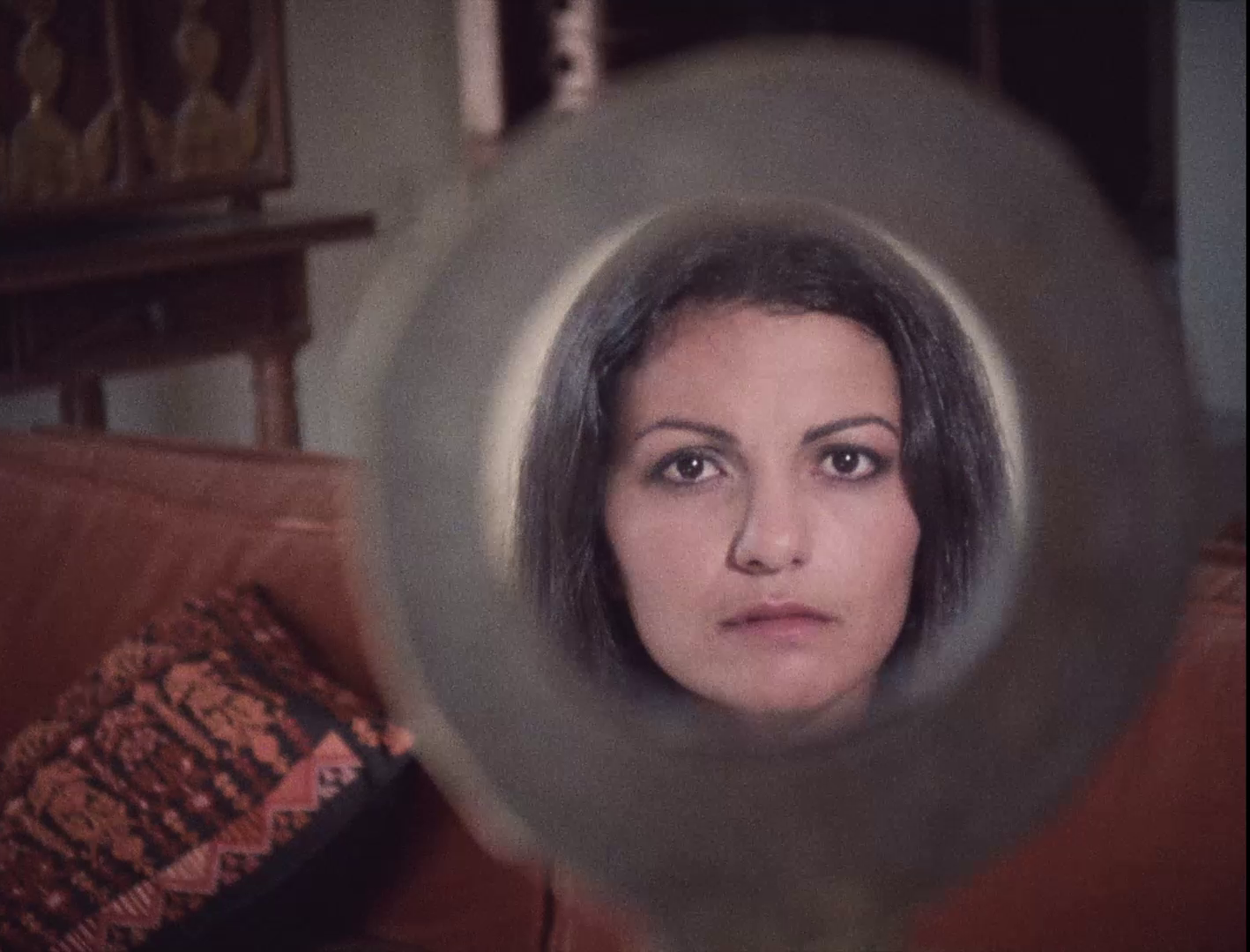
Image 9. Leila gazing into the future.

V: Through the Looking Glass

Srour adds further layers to her historical kaleidoscope with recurring poetic images, of veiled women sat on a beach in silence, of armed female fedayeen from various historical eras appearing in Leila’s London gallery, or of Leila gazing into a mirror and glimpsing her own future (Image 9). In that reflection, she sees a future where all cycles continue to repeat and where, as an ageing woman suspended in a fog of forgetfulness, she regurgitates to her granddaughters patriarchal maxims she once heard in her youth. Time becomes a third kind of erasure, after colonial and patriarchal-nationalist erasures — another reminder of how difficult moral judgment of the past ultimately is. But it’s Leila’s refusal to accept this future, or to accept her fiancé’s blanket statement erasing the part played by women, which drives the film’s journey between hope for the future and despair at the lack of change from one era to the next. If meaningful change is ever to occur, the film insists, it must begin by recognising women as historical agents rather than historical absences.

Leila and the Wolves has few precedents in Arab cinema. In literature, we might be compare it with Algerian novelist Assia Djebar, whose work also interconnects official archives and the unheard voices of women to rewrite national history from the margins, excavating stories of resistance that have been excluded from dominant historical narratives. Both Srour and Djebar foreground memory as a counter-archive to colonial and patriarchal historiography, insisting that the personal and oral testimonies of women are central to understanding broader struggles against subjugation. In this regard, Srour’s film feels more artistically radical than Jacir’s Palestine 36 (as urgently necessary as that film is in our age of historical amnesia). Leila and the Wolves endures not just as a radical feminist intervention bringing to life real experiences that have been obscured by time, but also as a landmark in modernist Arab cinema borrowing from a rich Arab heritage of storytelling and poetry.

The film stakes its power on oral testimony, on unofficial, unwritten narratives that survive only because women keep telling them, refusing to let their lived history be erased. Like the stories it resurrects, it itself attempts to be a beacon of memory fighting against oblivion, and its recent restoration will hopefully make it a bit more widely seen. It also stands as reminder that history does not sort itself into right and wrong on its own. So much remembering, retelling, and reckoning is in need of being done while at the same time so many forces prevent us from doing so. But alongside this warning, the film also carries a hard-earned hope, that even when the victors write history, the defeated and the forgotten can still speak back.

Further Reading:

Interview with Heiny Srour by Elhum Shakerifar on BFI website: https://www.bfi.org.uk/interviews/leila-wolves-40th-anniversary-heiny-srour-her-time-travelling-tale-arab-womanhood