
This article is part of My Faves of 1995, a series where I revisit some of my favourite films from that year. 1995 marked cinema’s centenary, but also a crossroads: poised between the end of the celluloid era and the dawn of digital, between Cold War geopolitics and a more globalised cultural map, a time when Hollywood indies and world cinema gems flourished side by side in ways they rarely do today. It also marked the first year of my burgeoning cinephilia, though I was far too young to catch most of these films on release. In this series I highlight the works that left their mark on me, why they’re worth (re)discovering, and why they still matter three decades later.
Devil in a Blue Dress
Director: Carl Franklin
Year: 1995
Country: USA
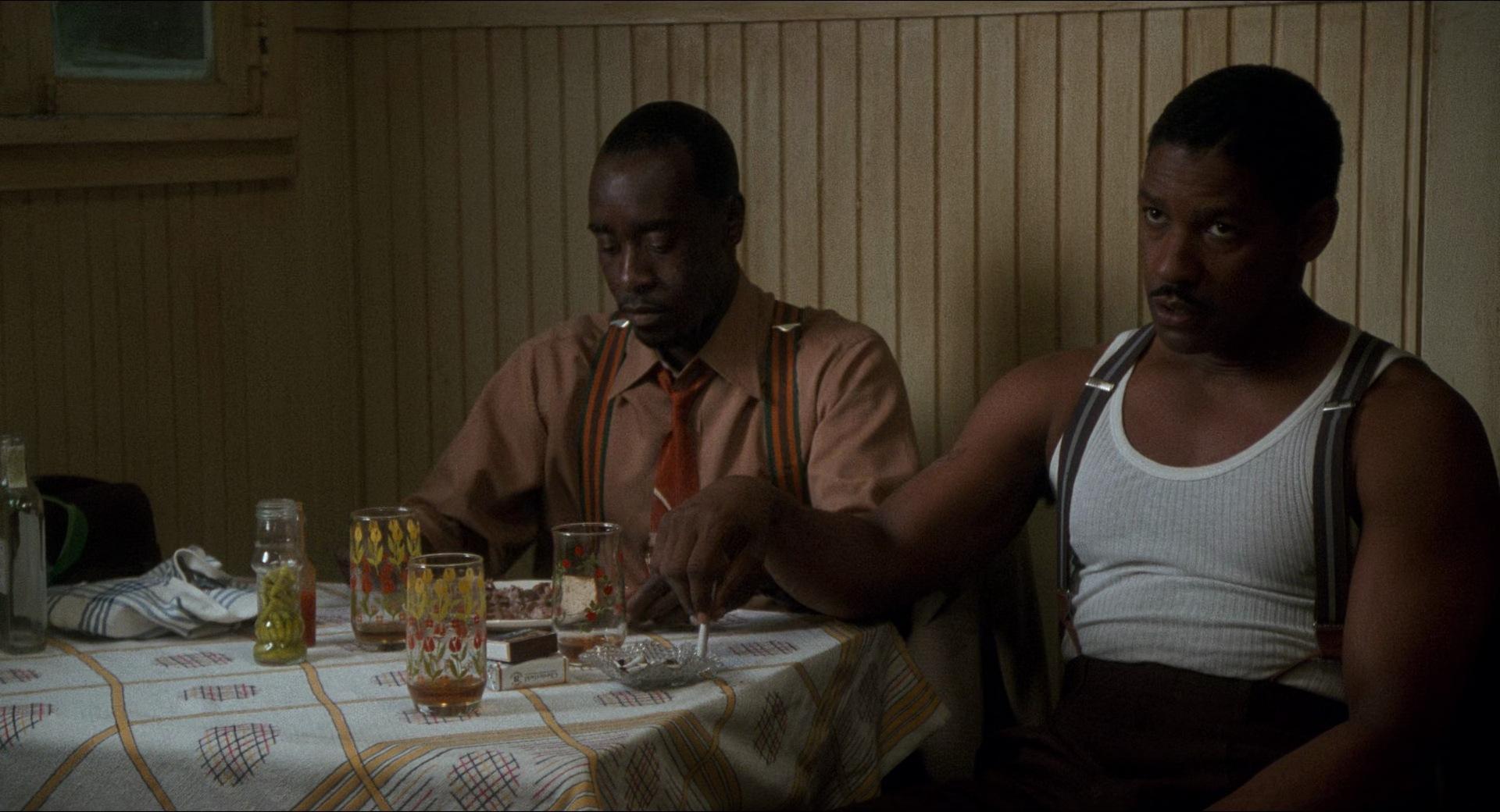
Carl Franklin’s Devil in a Blue Dress (1995), adapted from Walter Mosley’s bestselling novel, is one of the best neo-noirs of the 1990s. Set in the 1940s, it is reverently steeped in the traditions of classic noir: a labyrinthine plot, a mysterious femme fatale, smoky clubs, a reluctant detective whose investigation stumbles into corruption. But there’s a crucial twist here, reframing noir’s tropes through a different perspective: that of what W.E. Du Bois called the ‘colour line’, the lasting divisions of opportunities and experiences according to a racial divide. Classic noirs exposed hierarchies of wealth and social class, as well as the reckless short-cuts people took in trying to climb them, but race and ethnicity were invisible factors, with only rare exceptions like Sam Fuller’s The Crimson Kimono (1959). Here, Denzel Washington incarnates to perfection our protagonist, Ezekiel “Easy” Rawlins, not a hardboiled white private eye in the mould of Philip Marlowe or Sam Spade, but a Black WW2 vet, living in South Central Los Angeles in 1948.
The film opens with the evocation of a broader social panorama. To the sound of T-Bone Walker’s blues, the opening credits sequence glides across Archibald Motley’s painting of a crowded Black community scene, the camera slowly pulling back to reveal more of the bustling life captured in brush-strokes. From the outset Franklin signals that what follows is as much a portrait of African American community as it is a detective story. Los Angeles in 1948 was shaped by the Second Great Migration, when thousands of Black Southerners fleeing Jim Crow laws sought new lives in California, settling around the few neighbourhoods of L.A. that weren’t off limits to them, like Watts or South Central. There, with steady work in one of the aircraft assembly factories that had boomed during the war, a Black man might earn enough to buy himself a home, something systematically prevented in many other parts of the country. Realtors and mortgage lenders simply refused to deal with Black and immigrant families, further segregating them into urban geography’s colour line.

Easy Rawlins is a proud and pragmatic individual who must be understood through these larger social issues. Back from war in Europe, and employed in an aircraft factory, he put his G.I. Bill pay toward a modest bungalow in South Central, one of the rare districts where a Black man could own a home. For him, it signifies more than property: “I loved coming home,” he says in the snappy voiceover, “I guess maybe I just loved owning something.” In a system that allows him so little, here is something that is his. His homeownership is crucial to the story: where Chandler’s Marlowe or Hammett’s Spade are men who are never tied down, Easy Rawlins, by contrast, is rooted. His house symbolises a hard-won piece of the American Dream, but one constantly under threat from intruders, debt collectors, police, and his own precarious situation.
“It was summer 1948, and I needed money”
Noir plots are often set in motion by a job offer that seems too good to be true, and Devil in a Blue Dress plays knowingly with this trope. After being unfairly laid off at his factory, and desperate to keep up on his mortgage payments, Easy is approached by DeWitt Albright (Tom Sizemore), a Mephistophelian middleman who offers him quick cash to track down a missing woman by the name of Daphne Monet (Jennifer Beals).

Crucially, Easy accepts the job and becomes a makeshift private eye not out of bravado or greed, but because it is the only way to protect his most precious possession, his house. In a Los Angeles where moral and political corruption are rife (one of the subplots revolves around a scandal-riven mayoral election), and nocturnal scenes prevail in visualising the murkiness of the world Easy must navigate, it is telling that Franklin and cinematographer Tak Fujimoto film Easy’s house in diffuse, overexposed light, almost a romantic mood suggesting his only real emotional attachment is to this modest slice of ‘Paradise’ he strives to keep. Every intrusion into his house (and there are many in the film) feels like a sharp shock, always sneaking up on Easy and the viewer when we least expect it, and turning film noir’s tension into something more concrete: a portrait of the precarity of Black homeownership in postwar Los Angeles, constantly undermined by the systemic discrimination, surveillance, and violence of the colour line.
“The colour line in America works both ways”
Los Angeles has always been noir’s city, its boulevards and suburbs mapped as sites of violence and betrayal. Franklin’s film self-consciously plays with this tradition, most obviously invoking Chinatown (1974), but now integrates the informal segregation of the colour line into the city’s very geography. In the Black neighbourhoods of South Central, Watts, and along Central Avenue’s jazz clubs, Easy can move relatively freely and those employing him take advantage of this. Easy is hired precisely because he is Black: Daphne is said to frequent Black clubs and to “have a taste for Black men”, leading his search into Black spaces where white investigators or police could not easily enter.
But whenever he crosses into white spaces, danger escalates. Driving a white woman through a white neighbourhood, he muses on the voiceover: “I wasn’t nervous. I was stupid.” The film builds constant tension from this geography: every street is a threshold, every border crossing a risk of arrest, assault, or worse. The classic noir detectives, operating in books and movies where the pernicious effects of racism were mostly elided, are street-smart tough-talkers who can walk down any ‘mean streets’. Easy on the other hand is bound, due to his skin colour, by the same lines of racial segregation he is hired to slip through. Police harassment, racist taunts from white youths, and false suspicion at his every wrong move remind him (and us) of that.

This spatial dynamic extends to Daphne Monet, the supposed “devil in a blue dress” of the title. She appears at first to be a classic femme fatale, but proves to be a tragic figure, a victim of the oppressive male world who tries to navigate it as best she can, a la Evelyn Mulwray in Chinatown. Here too, complexity is added through the lens of race, Daphne’s own racial liminality across the ‘colour line’ being a crucial plot twist. Though passing as white, she is of mixed heritage: too Black for white society who damn her for spending too much time in ‘Black clubs’, and too white for Black society where she can only be an exotic guest. She may be able to, unlike Easy, freely cross the city’s various demarcations along the colour line, but (also unlike Easy) she has nowhere to belong, no roots. Through her character, Devil in a Blue Dress again reconfigures noir’s stock archetypes by placing the social realities of race at the centre of the narrative.

Noir, then and now
Devil in a Blue Dress thus works on multiple registers: as a stylish neo-noir faithfully updating the period ’40s atmosphere, as a social history of Black Los Angeles celebrating the resilience and community-building of its inhabitants, and as a meditation on the colour line. It’s a film of two historical moments. Set in 1948, it captures the contradictions of postwar America: the opportunities of migration and the G.I. Bill alongside the exclusions of spatial geography, of property realty, and of job discrimination. Made in 1995, in the wake of the Rodney King beating at the hands of police (1991) and the ensuing Los Angeles riots (1992), it resonated with the racial fractures of its present. And seen today, post-Trayvon Martin, post-BLM, when those fractures have only been glossed over rather than confronted, it holds no less relevance. It reminds us that noir can be not just an aesthetic style, but a lens on systemic prejudice, urban exclusion, and fragile dreams.
Easy Rawlins is not the archetypal lone wolf detective, but a Black man determined to hold onto his place in a city that constantly tries to strip it away. If the house stands at the centre of Devil in a Blue Dress, it is because the home is never safe, always in need of being defended. When Easy is initially reluctant to take on the job for fear of “getting mixed up in something”, the shady DeWitt Albright quips back that the second you “walk out the door, you’re mixed up in something” — and so the film confirms, mixed up with the colour line, with corruption, with the structure of Los Angeles, with the overwhelming legacy of social history. (August 2025)
 Cinescope