




“In the books I read I saw nothing about the workers. Only evocations of a mystical Africa, where people sit under the banana tree or the coconut tree and eat the fruit that falls from the branches. I said to myself, no! No! There is an Africa that is defiant, one that doesn’t cry over its past.”
Born: 8 January 1923, Ziguinchor, Senegal.
Died: 9 June 2007, Dakar, Senegal.
Directing Career: 1963 – 2004
Movement: African cinema, Third Cinema, Anticolonial cinema.
Traits: Starting out as an award-winning novelist writing in French, Sembène came to the realisation in the early 1960s that for his message to reach local audiences, the cinema would be a more germane medium. Therefore, even though he remained an important and active figure in francophone African literature, one of his concerns was always to make films with characters speaking African languages and dealing with African issues. In several cases, he adapted his own novels into films.
More specifically, he has widely explored questions of Senegal’s burgeoning post-colonial cultural and national identity in a variety of modes, be it through neo-realist depictions of the inner struggles of working-class characters, absurdist and witty satires of the African ruling bourgeoisie, or historical excavations of the colonialist legacy. As a committed African filmmaker, creating a film industry in a nation where there previously was none, he can rightfully be remembered as a founding pioneer of Sub-Saharan African cinema.
Collaborators: Makhourédia Guèye (actor), Mbissine Thérèse Diop (actress), Farba Sarr (actor), Georges Caristan (cinematographer).
Related Directors: Djibril Diop Mambety.
Films Reviewed:
Mandabi (1968)
Emitai (1971)
Camp de Thiaroye (1988)
1968
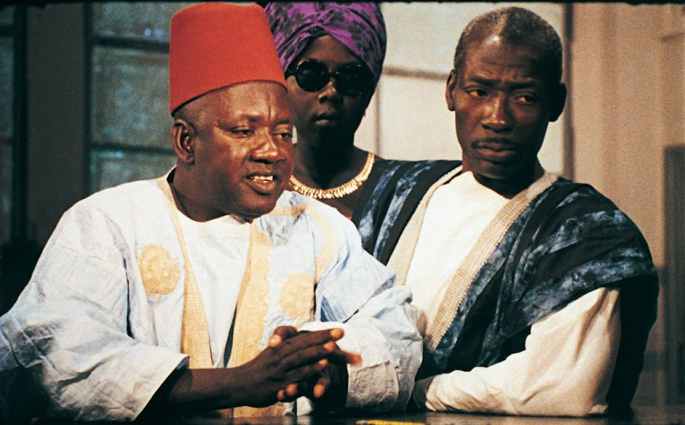
 Mandabi
One morning in the slums on the outskirts of Dakar, the happy-go-lucky Ibrahima Dieng (Makhourédia Guèye), a pious, middle-aged and unemployed man with two wives and many children to feed on a hand-to-mouth existence, is going about his daily routine. He does not yet know that a visit from the postman is about to turn his life upside down, making him the recipient of a money order, all the way from Paris no less, for the not inconsequential sum of 25,000 CFA Francs. But this tantalising promise of life-changing funds is still an abstract piece of paper that proves harder to pin down concretely: to cash it in Dieng must show an ID card, and to make an ID card he must have his birth certificate, and to dig up his birth certificate he must go to the town hall, and so on and so forth.
Needless to say, Dieng has none of these documents. Even his date of birth according to the Gregorian calendar is a mystery to him, and his inability to speak any French makes navigating this bureaucratic maze all the more impossible. In his traditional robes and red fez, Dieng seems a fish out of water in his own land, where a monetary system he never asked for and barely comprehends has been imposed upon him — throughout the film we glimpse his Islamic view of money, primarily as something to be passed on to those less well-off in order to ward off evil spirits, while any food he does buy is taken from the local shopkeeper on credit.
Now the allure of bona fide money changes Dieng and everyone around him. The more it is mentioned, anticipated, and hoped for without being seen, the more the mythology of this money order accrues. It becomes like the legend of a wild beast, its dimensions and abilities exaggerated out of all proportions the longer it remains unapprehended. Before the hapless Dieng has a chance to head to the post office, already the rumours have circulated regarding this magical piece of paper signed all the way from France. As gossip does the rounds, Dieng becomes the talk of the neighbourhood, some voices claiming, in part-admiration and part-jealousy, that Dieng is now rich and that the order is worth not 25,000 but 100,000 CFA. His wives count their chickens before they’ve hatched and bring home food enough for a feast on credit, only leading to an accumulation of debt. Acquaintances and relatives queue around his house asking for loans, desperate to pick up any scraps Dieng might leave for them.
But, as is always the way, there are bigger predators around the corner, to whom naive Diengs are but easy prey. On the opposite pole of the left-behind traditionalists like Dieng, the film posits ‘modern’ Senegalese in sync with the urbanisation and commercialisation taking over post-independence Dakar. One such shark is Mbaye, a young urban businessman who is Dieng’s cousin, converses in French, has a trendy wife (one rather than two like the more old-fashioned Dieng) who goes out by herself, and yet embodies only bottomless greed. He deliberately cons his own relative out of the money order, not just to cash in on its monetary value itself but to further sink Dieng into bankruptcy (ironically the money order leads not to credit but ubiquitous debts) so that the French developers Mbaye is in league with can buy Dieng’s house at a cutback price. Finally, just as we imagine Dieng to be left penniless, homeless and destitute, Sembène closes with a devillishly Brechtian ending tonally somewhere between hope for change and moral fable.
What makes this all the more bitter is that the money was not even meant for Dieng. It takes the teller at the post office (played by Sembène himself) to read the accompanying letter and explain that the money is in fact savings sent home by Dieng’s nephew Abdou from Paris, only 2,000 of which are for his uncle, 3,000 for his mother, and the rest to be saved for his return to Senegal. Over this reading of the letter, Sembène includes a crucial montage, showing us the only images from outside Dakar in the entire film: we see Abdou the exiled worker sweeping the streets in Paris, struggling to make a living but not forgetting his family back home (and arguably the only character to be spared the sharpness of Sembène’s satirical scythe). This totally de-mythologises this money and its provenance, at least for the audience if not for Dieng and the other characters whose expectations of wealth it has ignited. This money order is not the abstract symbol they take it to be, but fruits of the sweat and labour of their fellow Senegalese, a homesick immigrant toiling for opportunities in France. All this is evoked in a sequence of just three minutes, but anyone who had seen Sembène explore issues of exile and power hierarchy pitting African workers opposite white bosses in his debut feature Black Girl (1966) would know all that this brief aside implies.
When Mandabi was first released, Senegal had been independent just 8 years, under the leadership of Leopold Senghor, a man who despite any flaws was infinitely more cultivated than the dictators taking over Senegal’s neighbours at the time. But Sembène had reservations about where the new Senegalese society was heading and what it meant for ordinary citizens like Dieng, used to a very different way of life. It is not up to the artist to offer the solutions, but as a politically commited storyteller Sembène clearly wished to hold up a mirror to the ills, the greed, the corrosion of community, the losers and the winners he saw emerging in his country. The very fact he wanted to communicate it with as wide an African audience as he could and made Mandabi the first ever feature film to be fully in an African language, signifies his belief in the possibility of communication with his public, and thereby in some way for cinema to bring education and change, at least on a small scale. For the larger scale, the evidence of the even more biting satire Hyenas, made by the other great Senegalese filmmaker Djibril Diop Mambety a quarter of a century after Mandabi, suggests that globalisation and capitalism have certainly not spared West Africa. (November 2019)
1971
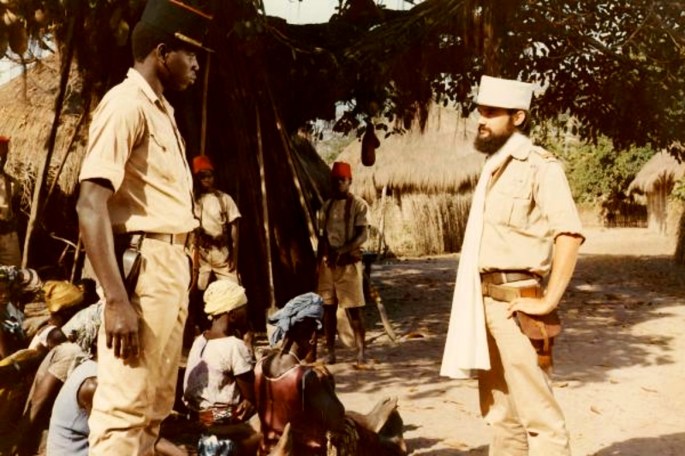
Emitai
Another essential film from the great griot of African cinema, Ousmane Sembène, Emitai (1971) is both a counter-history and a lyrical portrait of African life and resistance under colonial rule. Counter-history because it is based on a series of massacres that took place in 1942 in Casamance (the region of southern Senegal where Sembène himself was born), when the French army arrived to requisition rice for the war effort. Lyrical portrait of life and resistance for it shows the daily rhythm of villagers’ lives in which rice plays a vital role not only for nourishment but also for spiritual reasons, used as an offering in funerary rituals, so that they refuse to surrender their harvests. In several cases the soldiers opened fire, killing dozens.
Sembène’s choice of subject was personal, having himself served as a tirailleur in the Free French Army during WW2, and seeing first-hand the hypocrisy of fighting fascism abroad while being treated as colonial subjects at home was key to his political awakening. The so-called “masters” emerged from the War exposed as little more than aggressors cloaked in empty republican rhetoric. Emitai distils that realisation into cinematic form: French colonialism did not simply extract resources, it forced Africans to oppress one another, and it left its violence unacknowledged.

A Village under Siege
The film is set in a Diola village in Casamance. French soldiers arrive to confiscate rice, first through persuasion and then through intimidation. Understandably, the villagers do not fathom why they should give up their sacred rice for soldiers fighting a war they don’t understand, in distant lands they have never seen. When the villagers hide their reserves, troops raid homes, burn stores, and kidnap men to forcefully conscript them into the army. The village is effectively held hostage by a squadron of French troops, many of whom are Black African tirailleurs. It is Africans shooting at Africans, all in the name of supplying a distant European war.
In the same guise as Satyajit Ray‘s Distant Thunder (1973), a chronicle of a rural community unravelling under the Bengali famine of 1943, caused by the ‘distant thunder’ of a faraway war’s consequences, Sembène’s film too becomes a portrait of life during wartime in the colonies, the domino effects of the war having drastically oppressive effects on the colonised. Stylistically, Emitai combines observational realism with a loose rhythm and lyrical flourishes. Encounters unfold casually, and Sembène reveals the narrative at a leisurely pace, through episodic moments and ethnographic detail. He shows that by seizing rice, the army is not only starving bodies but also desecrating culture. He shows that putting up resistance against the mighty weaponry of the French army is an act of desperate courage. He shows also that the village’s leadership of elders are fractured, unsure how to react to the tremendous calamity befallen upon them.
These sad and bitter truths are revealed through small details. For instance, when posters on the village walls are changed from those of Pétain to De Gaulle to reflect a change of leadership in the so-called ‘Fatherland’, much to the bemusement of one tirailleur (Sembène himself in a comical cameo — “You’re having me on, how can this be the new leader of France when he has less military stars than the previous one?”). More than light relief, the scene makes a sharp point: no matter the leader’s face in France, the colonies remain under the same boot.

Old Gods and New Resistance
Who then can protect the village from this new tumult? The elders turn to the traditional ways, invoking their gods through the wearing of masks and asking them for succour from the colonisers’ brute force. These Diola religious rituals are shown with respect, and with some of the most uncharacteristically stylised scenes Sembène ever filmed, as if he had to transcend cinematic conventions in order to film them, using fragmented editing and colour filters to evoke a kind of spiritual experience. Even though Sembène was a Marxist atheist with little to no belief in these traditions, he nonetheless saw a great amount of importance in their ability to bring people together, to cement a genuinely African sense of culture and identity.
But he was also very wary of the fetishisation of this precolonial African folklore, especially in the then-fashionable concept of Négritude, espoused by Senegal’s founding President Leopold Senghor, a leader Sembène often clashed with. For Sembène, Négritude was a form of self-exoticism, vague and meaningless, perhaps seemingly comforting but ultimately insufficient for the real change he saw as necessary in Senegal and Africa. Emitai insists that precolonial traditions, while valuable, are not immune to critique, and that true independence requires moving beyond both colonial repression and passive nostalgia.
Hence the film also shows the limits of these old ways. The elders are too passive; the gods fall silent; the prayers go unanswered. Emitai, the name of one of the deities invoked, can do nothing to prevent the massacre. Here, in these desperately ineffective prayers of rural peasants, we are reminded of another Third Cinema classic, Chen Kaige‘s Yellow Earth (1984) and the famine-struck farmers of Shaanxi praying to their rain-gods to water the crops. The villagers’ passivity, their waiting for divine guidance, becomes part of Sembène’s critique: reverence and tradition is not enough when facing a belligerent colonial force. As always Sembène is making African cinema for African audiences — us Global North viewers will find so much to admire, and be remind that this too is our history, and we should not erase it, but we are not the target fo what he wants to say. The issues he raises are for Africans themselves to debate and build on, it is for them to find ways to transcend tradition and build a better future, one beyond both colonial repression and comforting illusions.

As often in Sembène’s filmography, it is up to the women to works toward this future and to take on a more active role in this challenge. They are the ones who stage protests, hide rice, resist soldiers physically. Women, closer to the rhythms of life and death through food and child-rearing, recognise that survival depends on resistance, not merely prayer. When the men are held hostage by the French, it is the women and the children who march warrior-like, in a complete inversion of traditional gender roles. Sembène gives the women the most courage and clarity, anticipating the central role women would play in fighting for real change in his final film, Moolaadé. In his vision of a Pan-African future, in a film dedicated to “all the militants of the African cause”, for women not to have a leading role would be unthinkable for Sembène.
But, finally, Sembène is no mythologist. As a cinematic griot, his self-perceived role was to tell stories that held power to account. No everyday acts of resistance could undo the massacre — Sembène insists on facing history squarely, wresting back history from the forced silence with which colonial power cloaked it. What began as a portrait of village life — rice harvests, rituals, humour, debate — ends with wanton bloodshed. The villagers are left to grieve, to bury their dead, to reckon with the silence of both their gods and the colonial masters who exploit them. Emitai is is of a piece with Camp de Thiaroye (1988), his later film about African soldiers massacred by French troops in 1944 for going on striking against the racist treatment of the French army. Both works are about refusal: refusal of France’s silence, refusal of official amnesia, refusal of mythologies that disguise reality. (October 2025)
1988

 Camp de Thiaroye
Late 1944, a few months after the liberation of Paris. At the port of Dakar, Senegal, West African infantrymen are disembarking after years of service in Europe and North Africa, or of confinement in German concentration camps for some of them. There is little fanfare to tell you these men, alongside the Arabs and Berbers of France’s North African colonies, made up two thirds of General De Gaulle’s Free French Army who fought to win back France. Indeed De Gaulle made sure the liberation itself was a whitewashed PR campaign: black soldiers were replaced by white soldiers for the march into Paris and subsequent celebrations. When evacuating from the beaches of Dunkirk, it was again the black soldiers who were at the very back of the queue, easy pickings for the Nazi snipers or abandoned altogether — however much of a powerfully immersive experience Nolan’s film is, it makes no mention of this.
Waiting to be officially given leave and remunerated the four years of backpay they were promised, the men are housed in the Camp de Thiaroye, treated as third-rate soldiers, denied the same privileges as their French counterparts, served up with meals worse than those they fed on as POWs. They represent a transition point in the history of colonial empire, for how can they return to being the same docile subjects believing in the myth of white superiority as before, when it is they who have given their blood for the depleted occupied ‘Motherland’. It becomes clear to the French generals and captains, paternalistic and condescending in their racism with the one exception of the enlightened but naively idealistic Captain Raymond, that as the war for France has been won another battle is starting: one for the empire itself. So when they decide to renege on their (worthless) word of honour and cut the soldiers’ salary by half, there is more at stake for them than mere penny-pinching — they want to put these men who risked life and limb for France back in their ‘place’. The result was the massacre of hundreds of unarmed Africans, who despite being French soldiers, were summarily executed in an incident for which the French government has never apologised.
Sembène, giant of African cinema and a soldier in the French Army from 1942 to 1944, draws partly on his autobiographical experiences to bring this shameful episode of France’s history to screen. Sergeant Diatta (Ibrahima Sane), an intellectual law student married to a Frenchwoman and who speaks French better than his French superiors, is clearly the character in which we most recognise the literary erudition of Sembène. It is however the character of the ‘wise fool’, Pays, a mute traumatised by his experiences at Buchenwald and incarnated by the malleable facial features of the great Ivorian actor Sidiki Bakaba, who perhaps steals the show. Before the final massacre, it is he from his sentry post who sees the tanks coming, but as he associates this invasion with German soldiers and cannot verbalise what he has seen, all the camp’s residents think he is merely hallucinating again and head back to bed. For the French government (who banned the film for 10 years), this direct comparison between the actions of the French military and Nazism was too much to take, and many critics dismissed it at the time as too ‘on-the-nose’ — but it is just as subtle as it needs to be when dealing with the horrors humans committed against other humans in the name of imperialism.
Individuals aside, the film is an ensemble panorama of life at the camp, and episodic in the best sense, allowing its characters and events freedom to roam and rhyme with each other across its ample 150-minute running time, and providing an overarching sense of pan-African community: men from Senegal, Niger, Cote d’Ivoire, Gabon, Chad, Burkina Faso, even an African-American G.I. who patches things up with Diatta after starting off on the wrong foot. There is a solidarity there, and even a traditional democracy when each barrack elects a representative to go and discuss the pay situation with the French officials. Camp de Thiaroye offers an epic-scale revision and correction of the official version of history, bringing to light not just the unsung efforts of Africans in WW2 but also their agency in the history of Africa itself. (September 2018)
 Cinescope
2 thoughts on “Ousmane Sembène (Director)”