
New review below added to Ousmane Sembène director page.
Emitai
Director: Ousmane Sembène
Year: 1971
Country: Senegal
Another essential film from the great griot of African cinema, Ousmane Sembène, Emitai (1971) is both a counter-history and a lyrical portrait of African life and resistance under colonial rule. Counter-history because it is based on a series of massacres that took place in 1942 in Casamance (the region of southern Senegal where Sembène himself was born), when the French army arrived to requisition rice for the war effort. Lyrical portrait of life and resistance for it shows the daily rhythm of villagers’ lives in which rice plays a vital role not only for nourishment but also for spiritual reasons, used as an offering in funerary rituals, so that they refuse to surrender their harvests. In several cases the soldiers opened fire, killing dozens.
Sembène’s choice of subject was personal, having himself served as a tirailleur in the Free French Army during WW2, and seeing first-hand the hypocrisy of fighting fascism abroad while being treated as colonial subjects at home was key to his political awakening. The so-called “masters” emerged from the War exposed as little more than aggressors cloaked in empty republican rhetoric. Emitai distils that realisation into cinematic form: French colonialism did not simply extract resources, it forced Africans to oppress one another, and it left its violence unacknowledged.

A Village under Siege
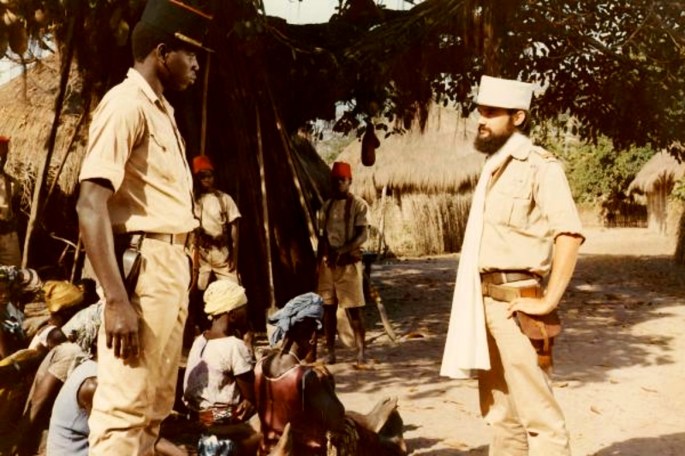
The film is set in a Diola village in Casamance. French soldiers arrive to confiscate rice, first through persuasion and then through intimidation. Understandably, the villagers do not fathom why they should give up their sacred rice for soldiers fighting a war they don’t understand, in distant lands they have never seen. When the villagers hide their reserves, troops raid homes, burn stores, and kidnap men to forcefully conscript them into the army. The village is effectively held hostage by a squadron of French troops, many of whom are Black African tirailleurs. It is Africans shooting at Africans, all in the name of supplying a distant European war.
In the same guise as Satyajit Ray‘s Distant Thunder (1973), a chronicle of a rural community unravelling under the Bengali famine of 1943, caused by the ‘distant thunder’ of a faraway war’s consequences, Sembène’s film too becomes a portrait of life during wartime in the colonies, the domino effects of the war having drastically oppressive effects on the colonised. Stylistically, Emitai combines observational realism with a loose rhythm and lyrical flourishes. Encounters unfold casually, and Sembène reveals the narrative at a leisurely pace, through episodic moments and ethnographic detail. He shows that by seizing rice, the army is not only starving bodies but also desecrating culture. He shows that putting a resistance against the mighty weaponry of the French army is an act of desperate courage. He shows also that the village’s leadership of elders are fractured, unsure how to react to this tremendous calamity befallen upon them.
These sad and bitter truths are revealed through small details. For instance, when posters on the village walls are changed from those of Pétain to De Gaulle to reflect a change of leadership in the so-called ‘Fatherland’, much to the bemusement of one tirailleur (Sembène himself in a comical cameo — “You’re having me on, how can this be the new leader of France when he has less military stars than the previous one?”). More than light relief, the scene makes a sharp point: no matter the leader’s face in France, the colonies remain under the same boot.

Old Gods and New Resistance
Who then can protect the village from this new tumult? The elders turn to the traditional ways, invoking their gods through the wearing of masks and asking them for succour from the colonisers’ brute force. These Diola religious rituals are shown with respect, and with some of the most uncharacteristically stylised scenes Sembène ever filmed, as if he had to transcend cinematic conventions in order to film them, using fragmented editing and colour filters to evoke a kind of spiritual experience. Even though Sembène was a Marxist atheist with little to no belief in these traditions, he nonetheless saw a great amount of importance in their ability to bring people together, to cement a genuinely African sense of culture and identity.
But he was also very wary of the fetishisation of this precolonial African folklore, especially in the then-fashionable concept of Négritude, espoused by Senegal’s founding President Leopold Senghor, a leader Sembène often clashed with. For Sembène, Négritude was a form of self-exoticism, vague and meaningless, perhaps seemingly comforting but ultimately insufficient for the real change he saw as necessary in Senegal and Africa. Emitai insists that precolonial traditions, while valuable, are not immune to critique, and that true independence requires moving beyond both colonial repression and passive nostalgia.
Hence the film also shows the limits of these old ways. The elders are too passive; the gods fall silent; the prayers go unanswered. Emitai, the name of one of the deities invoked, can do nothing to prevent the massacre. Here, in these desperately ineffective prayers of rural peasants, we are reminded of another Third Cinema classic, Chen Kaige‘s Yellow Earth (1984) and the famine-struck farmers of Shaanxi praying to their rain-gods to water the crops. The villagers’ passivity, their waiting for divine guidance, becomes part of Sembène’s critique: reverence and tradition is not enough when facing a belligerent colonial force. As always Sembène is making African cinema for African audiences — Global North viewers will find so much to admire, and be reminded that this too is our history, and we should not erase it, but we are not the target for what he wants to say. The issues he raises are for Africans themselves to debate and build on, it is for them to find ways to transcend tradition and build a better future beyond both colonial repression and comforting illusions.

As often in Sembène’s filmography, it is up to the women to works toward this future and to take on a more active role in this challenge. They are the ones who stage protests, hide rice, resist soldiers physically. Women, closer to the rhythms of life and death through food and child-rearing, recognise that survival depends on resistance, not merely prayer. When the men are held hostage by the French, it is the women and the children who march warrior-like, in a complete inversion of traditional gender roles. Sembène gives the women the most courage and clarity, anticipating the central role women would play in fighting for real change in his final film, Moolaadé. In his vision of a Pan-African future, in a film dedicated to “all the militants of the African cause”, for women not to have a leading role would be unthinkable for Sembène.
But, finally, Sembène is no mythologist. As a cinematic griot, his self-perceived role was to tell stories that held power to account. No everyday acts of resistance could undo the massacre — Sembène insists on facing history squarely, wresting back history from the forced silence with which colonial power cloaked it. What began as a portrait of village life — rice harvests, rituals, humour, debate — ends with wanton bloodshed. The villagers are left to grieve, to bury their dead, to reckon with the silence of both their gods and the colonial masters who exploit them. Emitai is is of a piece with Camp de Thiaroye (1988), his later film about African soldiers massacred by French troops in 1944 for going on striking against the racist treatment of the French army. Both works are about refusal: refusal of France’s silence, refusal of official amnesia, refusal of mythologies that disguise reality.
 Cinescope