

This essay is part of CineScope’s ongoing series on films that challenge the erasure of Palestinian history. From time-travelling mosaics to archival counter-histories, these works resist silence and restore memory. You can read more in the series here and find my original newsletter introducing the series on Substack here.
Ma’loul Celebrates Its Destruction
Director: Michel Khleifi
Year: 1984
Country: Palestine/Belgium.
Ma’loul Celebrates Its Destruction. Already, the title captures a paradox. Ma’loul was once a Palestinian village, about 6km west of Nazareth, with a mixed population of Muslim and Christian Arabs who’d lived there for generations. In July 1948, it was depopulated and razed to the ground during ‘Operation Dekel’, an Israeli offensive to consolidate control of the Lower Galilee region. All buildings bar two churches and one mosque were destroyed, its existence erased from the map, its people internally displaced. Most of them moved to Nazareth, making them internal refugees in the new nation-state of Israel, only a few kilometres from their former homes, which now survived only in their collective memory. Ma’loulites henceforth had the official status of ‘present absentees’ — present in Israel, but legally considered absent from their property, which now came under state control. The fact their village, homes, and land had been legally reclassified as no longer theirs, added insult on top of the injury of destruction.
What about the ‘celebration’ part? Well, despite strict state control of the land which once was Ma’loul, and despite the movement restrictions on Palestinian citizens of Israel, on one day per year Ma’loul’s former residents are permitted to visit their village. That day is Israeli Independence Day, the only day on which Ma’loul’s former residents are allowed to return without needing official permit passes. And so, they do. This brief return to Palestinian lost land juxtaposes with a ‘celebration’ of Israeli national triumph. Michel Khleifi’s documentary takes this paradox and explores how one side’s commemoration of gaining rights coincides with the other’s mourning of their own lost rights.
How do we remember where we lived? Try to picture the home you grew up in, the one you spent most of your childhood years in. Not just its exterior, but its interior logic: the way rooms connected, the position of doors and windows, what view you had out of your bedroom window. Chances are you could sketch a rough floorplan from memory even years or decades later. Memory is deeply topological, it attaches itself to space, to rooms, to paths and thresholds, to the physical coordinates of everyday life. To lose that forever is not merely the loss of physical property. It is the severing of memory from place, creating a gap that can never be filled.
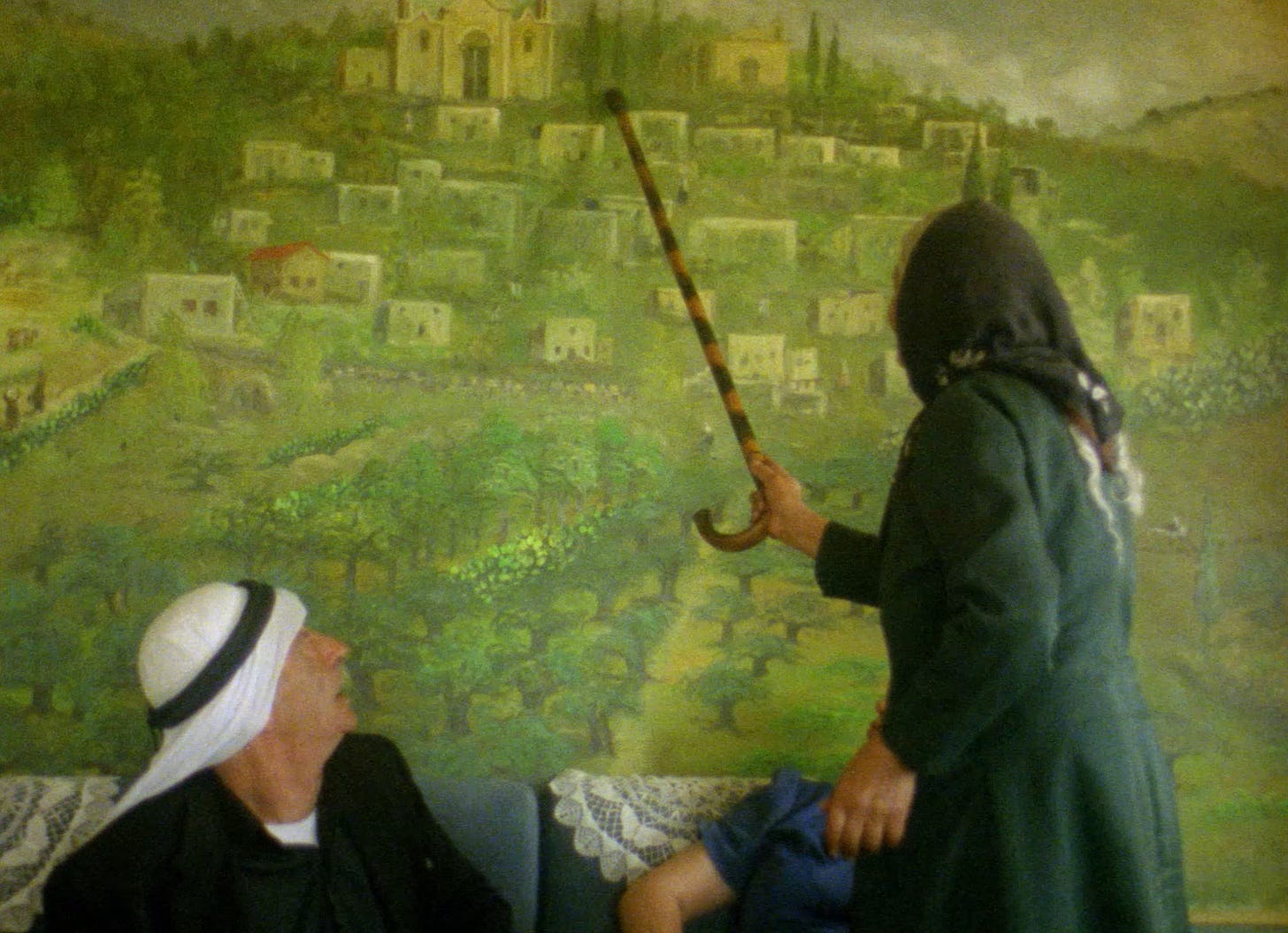
A remembered, mental floorplan is all that remains of Ma’loul as lived-in village now. Inside a house in nearby Nazareth, Khleifi films several former Ma’loul residents gathered around a large painting of Ma’loul, commissioned as an aide-mémoire. Khleifi’s camera often hovers over it in close-ups, reminding us that Ma’loul’s memory survives only in fragile fragments. The painting itself is not authoritative — a painter who never saw the village as it was recreated it from survivors’ decades-old memories — some details are disputed, but mostly the memories of the place remain strong. Villagers remember where fields, houses, olive groves, cactus trees, and paths once were. The discussions and reminiscences of these old-timers thus function as a collectively negotiated archive of memory.
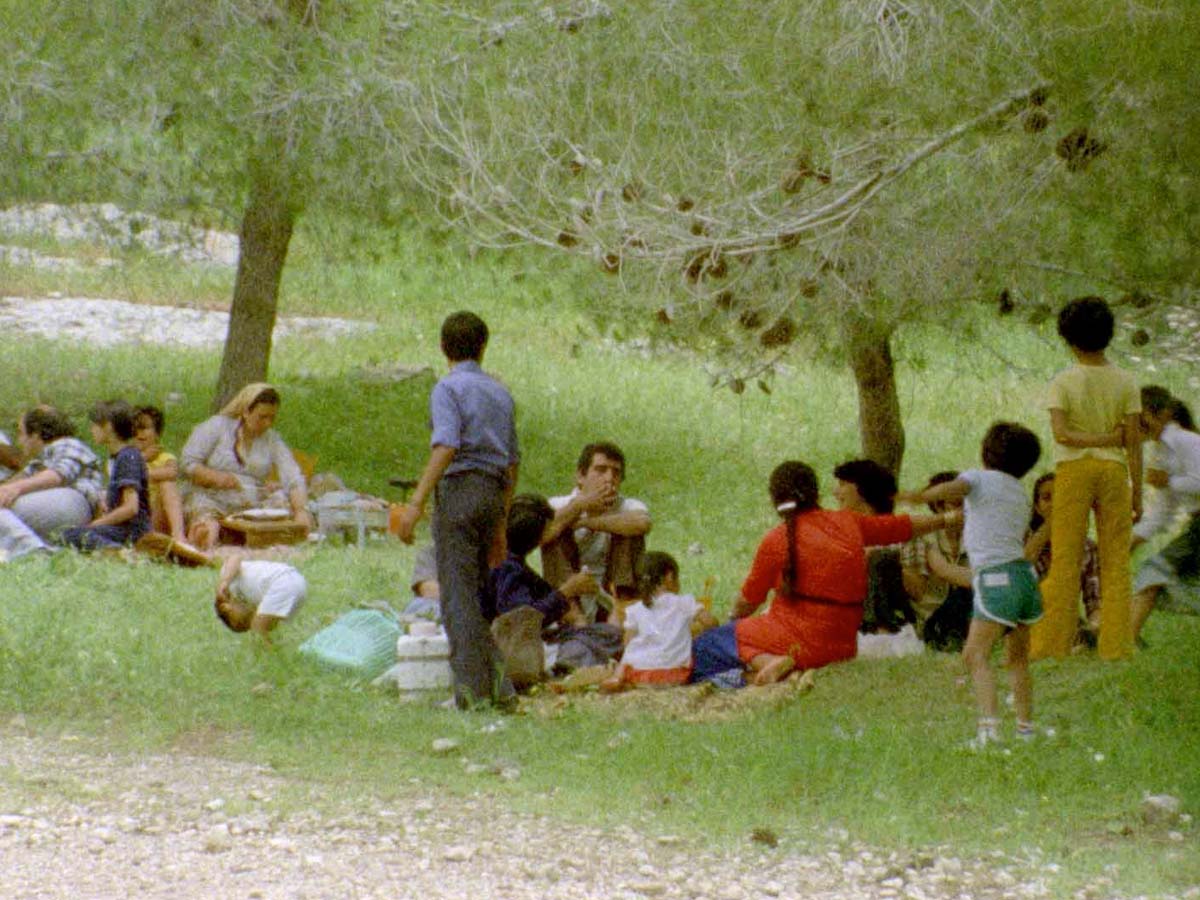
Khleifi deepens his survey of this intimate bond between land and memory with shots of people actually visiting the land where Ma’loul was, as part of their ritualised act of return and remembrance. Families picnic among the ruins, grill meat, drink arak, and let children run through tall, dry grass growing over collapsed stone. But this ‘charitable’ offering from the state of Israel of an outing to the graveyard of one’s own past is bittersweet, with all that once stood in it erased from sight, hence a constant reminder of a wound brought about by loss and trauma. Why do they still, without fail, return every year then? One man tells Khleifi’s camera that they come “to remember old times,” another says it is to show the children where their grandparents lived. A woman speaks of still feeling like a deracinated refugee now living in the city, of the loss of agricultural skills and self-sufficiency they had when living on and working the land. Her words speak to a need to remember this process, to not merely accept it despite the powerlessness.
Throughout the film, Khleifi weaves shots of only legs and feet walking through dry grass, never revealing the full figure. Similar to the roving close-ups of the painting, the effect of these shots is one of fragmentation and incompleteness, a body severed from its roots, mirroring the villagers’ own condition. Sound design suggests the haunting of what once was there. As the footsteps crunch on the dry grass, we also hear a clock ticking faintly, or children singing somewhere offscreen, an acoustic residue of a life that once animated this land but which now only exists fleetingly on one day of the year. These short-lived sounds do not resurrect Ma’loul so much as confirm its irretrievability.
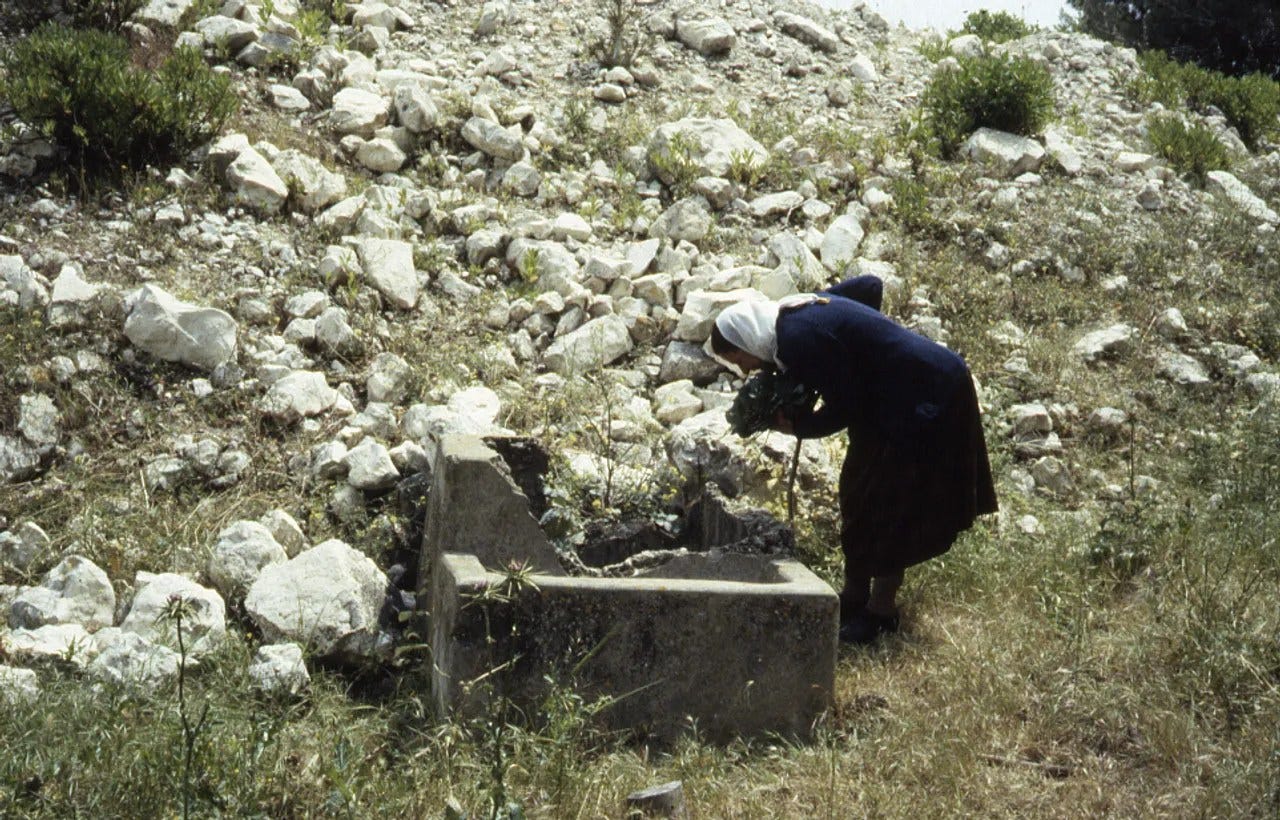
One of the film’s quietly devastating moments comes when Khleifi asks a simple question: where were the cemeteries? “They’re gone,” a man replies, and the camera shows a brief shot of eroded tombstones. This literal proof of roots on this land, of generations embedded in the soil, of belonging that extends beyond the living, this too has been erased, completing the lie of the slogan “a land without a people”. It is a deliberate erasure. Under Israel’s Absentees’ Property Law of 1950, Ma’loul’s land was designated “absentee property,” and its former citizens defined into legal non-persons, thus enabling the bureaucratic justification of confiscation and repurposing of the land.
For the new Israeli colonists, Ma’loul (and most of Palestine) was part of their wider project of “liberating” and “redeeming” the land. For the Palestinians, places like Ma’loul came to epitomise their dispossession and disenfranchisement by Israel. On one level, Khleifi’s documentary opens a whole meditation on the issue of land, laws and rights. How does land come to be owned, and by whom? How does it become ‘private property’? According to what kind of processes and measures? By legal-bureaucratic means? Or by means of force and coercion? In Ma’loul, it was the latter cloaked under the mask of the former. Increasingly, in our precarious neo-colonial world it is becoming the latter without even any bother at masking the logic of “might is right” anymore.
Watching it again now, it is impossible not to ponder on parallels with Gaza. Not parallels of scale or suffering, but of political logic. In both cases, the decisive move is not only violence and destruction, but the displacement of people and of their agency. Where Ma’loul’s residents lost control through legal-administrative mechanisms, Gazans today, whose homes have been destroyed or who have been forced to leave, risk a related outcome: political-administrative governance from outside without their own say or agency in building a future for themselves. Gaza’s reconstruction, if externally governed whether by Trump’s ‘Arab Riviera’ private-capital free-for-all or by the no-less-suspicious international project overseen by war criminal Tony Blair, risks reproducing the same loss, dispossession, and erasure, rather than self-determination.
What Ma’loul Celebrates Its Destruction ultimately reveals is that the Nakba was not only a moment of violence, flight, and demolition, but a longer process of political reconfiguration. The decisive act was not simply expulsion; it was the reassignment of agency. Dispossession did not end in 1948. It was consolidated through interlocking legal and bureaucratic mechanisms that turned villages into categories, people into cases. Ma’loul exemplifies this transformation, and is thus a salient focus for Khleifi’s film. From a lived-in place of labour and community into the legal abstraction of “absentee property”, from a village into a condition — and its loss is ongoing. It behooves all of us to know these histories better, to go beyond the narratives spoon-fed to us, and toward that aim cinema is a powerful, useful tool.
Especially the films of Michel Khleifi, a filmmaker who would be hailed as a great artist were he from anywhere else, but his destiny has been to employ his considerable artistic skills in the service of his beleaguered, oppressed nation. Throughout the film, Khleifi remains a restrained interlocutor, at times even playing devil’s advocate. He asks one elderly ex-resident, “After 30 years, shouldn’t we forget?” The answer is immediate and firm: forgetting is impossible. Even for those who never knew Ma’loul as it once was, time and loss only intensifies the sense of attachment, of injustice, of the moral imperative to refuse erasure. The idea that people would simply “get over it,” losing both their land and their history, is naive at best, utterly hypocritical at worst (those with the most in this world have done and will do just about anything to never relinquish more than an iota of what they have).
40 years on from this film, and with the memory of Ma’loul’s physical existence receding ever further into the fog of historical distance, people still continue to visit it yearly on Israel’s Independence Day.
 Cinescope